Year-End Tax Prep Checklist for Small Business Owners

A year-end tax prep checklist is the structured process of reviewing income, deductions, and compliance obligations before december 31 to minimize tax liability and avoid IRS penalties. For small business owners and freelancers, the stakes are higher than for W-2 employees. You control your own withholding, your own recordkeeping, and your own deadlines. The 2026 tax year brings significant rule changes under the One Big Beautiful Budget Act (OBBBA), including restored 100% bonus depreciation and new Roth catch-up requirements, making a disciplined, month-by-month approach more critical than ever.
1. When to start your year-end tax prep checklist
Year-end tax planning is ideally started in early Q4, specifically october, to allow 8–10 weeks for income projection and meaningful tax moves. Starting in december limits nearly every option available to you. Tax-loss harvesting, Roth conversions, and charitable bunching all require lead time to execute correctly.
The right mental model is a three-phase calendar: october for review, november for decisions, and december for execution. Each phase has a distinct purpose, and collapsing them into a single december scramble produces rushed errors and missed deductions.

Pro Tip: Treat november 1 as your personal tax deadline for decisions. By that date, your income projection should be complete and your major moves should be chosen. December is only for pulling triggers, not for thinking.
Why october matters more than december
Tax-loss harvesting requires selling investments and then waiting 31 days before repurchasing the same security to comply with wash sale rules. That 31-day window closes the door on any sale made after november 30. If you wait until december to review your portfolio, you have already lost the ability to harvest losses cleanly before year-end.
Income projection in october also gives you time to adjust estimated tax payments. The IRS operates on a pay-as-you-go system, and underpayment penalties apply when you fall short of the safe harbor thresholds: 90% of the current year's tax liability or 100% of the prior year's tax (110% for high earners). Knowing your projected income in october gives you time to make a Q3 or Q4 estimated payment correction before the january 15, 2027 deadline.
2. Essential documents to gather before filing
Accurate tax filing starts with complete records. Missing a single 1099 or misplacing a payroll report can trigger an IRS notice, a penalty, or an amended return. Gather these documents before you begin any review:
- Income records: W-2s, 1099-NEC, 1099-K, 1099-MISC, and any other income statements
- Business financials: profit and loss statement, balance sheet, and accounts receivable aging report
- Bank and credit card statements: all accounts used for business transactions, covering the full calendar year
- Payroll records: quarterly 941 filings, state payroll reports, and owner compensation records
- Expense receipts: categorized by IRS Schedule C line items, including home office, vehicle, and equipment
- Prior-year return: used to verify carryforward items and confirm safe harbor payment levels
- Estimated tax payment records: dates and amounts paid for all four 2026 quarters
Federal tax forms including W-2s and 1099s for 2026 are issued by february 2, 2027, with individual returns due april 15, 2027. That timeline sounds generous, but the document-gathering phase takes longer than most business owners expect, especially when bank statements span multiple accounts and institutions.
Pro Tip: Use Taxbatchpro to convert scanned bank and credit card statement PDFs into structured, IRS-ready Excel spreadsheets. The platform maps transactions to Schedule C categories automatically, cutting hours of manual transcription down to under 90 seconds per year of statements.
3. Month-by-month checklist: october through december
Proactive tax planning works best over a monthly cycle. The table below summarizes the critical actions and deadlines for each month.
| Month | Key Actions | Hard Deadlines |
|---|---|---|
| October | Project full-year income; review estimated payments; initiate tax-loss harvesting | Sell investments by late october for wash sale compliance |
| November | Finalize charitable giving strategy; decide on Roth conversions; confirm retirement contribution amounts | Coordinate Roth catch-up with payroll by mid-november |
| December | Max out 401(k) contributions; place equipment in service; prepay deductible expenses if beneficial | December 31 for all year-end transactions |
October actions
- Pull year-to-date financials from your accounting records and project full-year net income.
- Compare projected tax liability against payments made so far.
- Identify losing investment positions and evaluate tax-loss harvesting opportunities.
- Confirm your Q3 estimated payment was made and assess whether a Q4 adjustment is needed.
November actions
- Finalize your charitable giving plan. Starting in 2026, charitable deductions for itemizers only apply to contributions exceeding 0.5% of adjusted gross income, making donor-advised fund bunching a common strategy.
- Decide whether a Roth conversion makes sense given your projected bracket.
- Confirm retirement contribution elections with your payroll provider.
December actions
- Max out Solo 401(k) employee contributions before december 31. Employee contributions for 2026 must be made by december 31, with a limit of $24,500 or $32,500 with catch-up.
- Place any qualifying equipment in service. Under OBBBA, 100% bonus depreciation is restored for 2026, but equipment must be physically placed in service by december 31. Payment alone does not qualify.
- Prepay january business expenses if you are a cash-basis taxpayer and expect a lower bracket next year.
- Make final estimated tax payment if needed before the january 15, 2027 deadline.
4. Tax strategies to maximize deductions in 2026
The most effective year-end strategies for small business owners and freelancers in 2026 center on timing, retirement contributions, and the new legislative thresholds introduced by OBBBA.
- Tax-loss harvesting: Losses offset capital gains dollar-for-dollar. Excess losses up to $3,000 offset ordinary income. Sell by early november to clear the 31-day wash sale window before december 31.
- Charitable giving: Bundle multiple years of donations into a donor-advised fund in one year to clear the new 0.5% AGI floor and itemize effectively.
- Retirement contributions: SEP-IRA and employer-side Solo 401(k) contributions can be made up to the tax-filing deadline with extensions, giving you flexibility after december 31.
- Section 179 and bonus depreciation: Purchase and place equipment in service before december 31 to claim the full deduction under restored 100% bonus depreciation.
- Income and expense timing: Cash-basis taxpayers can defer december invoices to january or accelerate deductible expenses into december to shift income between tax years.
Pro Tip: High earners aged 50 or older with W-2 wages above $150,000 must code 401(k) catch-up contributions as Roth starting in 2026 under SECURE 2.0. Coordinate with your payroll provider by mid-december. Missing this step risks disallowed deductions.
5. How to conduct a year-end tax planning review
A year-end tax review does not need to predict your exact refund. Its purpose is to verify that sufficient tax has been paid and that your records are accurate enough to file without errors or amendments.
Work through this verification checklist before you close your books for the year:
- Confirm total income matches across your bank statements, invoices, and accounting records.
- Verify that all estimated tax payments are recorded with correct dates and amounts.
- Review business expense categories for accuracy. Misclassified expenses are a common audit trigger.
- Confirm owner compensation is documented correctly, especially for S-corp reasonable salary requirements.
- Check that all payroll filings (Form 941) match your payroll records and W-2 totals.
- Decide whether your situation warrants a CPA review before filing. Complex returns with multiple income streams, rental properties, or significant asset sales benefit from professional due diligence.
For freelancers managing multiple client income streams, a self-employed tax prep review adds one more layer: confirming that every 1099 received matches your own income records. Discrepancies between what clients report and what you report are a known IRS matching trigger.
The 2026 OBBBA legislative changes affect thresholds across multiple categories. Verifying that your planning assumptions reflect the current year's rules, not 2025 rules, is a critical step in any quality-control review.
Key takeaways
A structured, month-by-month year-end tax prep checklist is the single most effective way for small business owners and freelancers to maximize deductions, meet 2026 deadlines, and avoid IRS penalties.
| Point | Details |
|---|---|
| Start in october | Begin income projection and tax-loss harvesting in october to preserve all available options. |
| Gather records early | Collect bank statements, 1099s, payroll reports, and expense receipts before december 31. |
| Know the 2026 rules | OBBBA changes affect bonus depreciation, charitable deductions, and Roth catch-up requirements. |
| Verify payments | Confirm estimated tax payments meet IRS safe harbor thresholds to avoid underpayment penalties. |
| Use technology | Taxbatchpro converts bank statement PDFs to IRS-ready spreadsheets, cutting manual data entry significantly. |
Why I think most business owners get year-end tax prep backwards
After years of watching small business owners and freelancers approach tax season, the most common mistake is treating december as the planning month. It is not. December is the execution month. By the time most people open their books in december, the best moves are already off the table.
Tax-loss harvesting closed in early november. The window for adjusting payroll withholding has passed. The opportunity to shift income between years required a decision weeks earlier. What remains in december is a narrow set of actions: max out retirement accounts, place equipment in service, and make final estimated payments. Those are real moves, but they are the last 20% of what a full Q4 plan delivers.
The business owners who consistently pay less tax are not smarter. They start earlier. They treat october as a financial review month, not a busy season to push through. They know their projected income by halloween, and they make deliberate decisions in november while options still exist.
My strongest recommendation is to organize business expenses continuously throughout the year so that your october review takes hours, not weeks. When your records are current and categorized, the year-end review becomes a verification exercise rather than a reconstruction project. That difference in preparation is what separates a confident filing from a stressful one.
— Ian
Taxbatchpro makes year-end document prep faster and more accurate
Year-end tax preparation stalls when bank statements are scattered across multiple accounts and formats. Taxbatchpro solves that bottleneck directly.
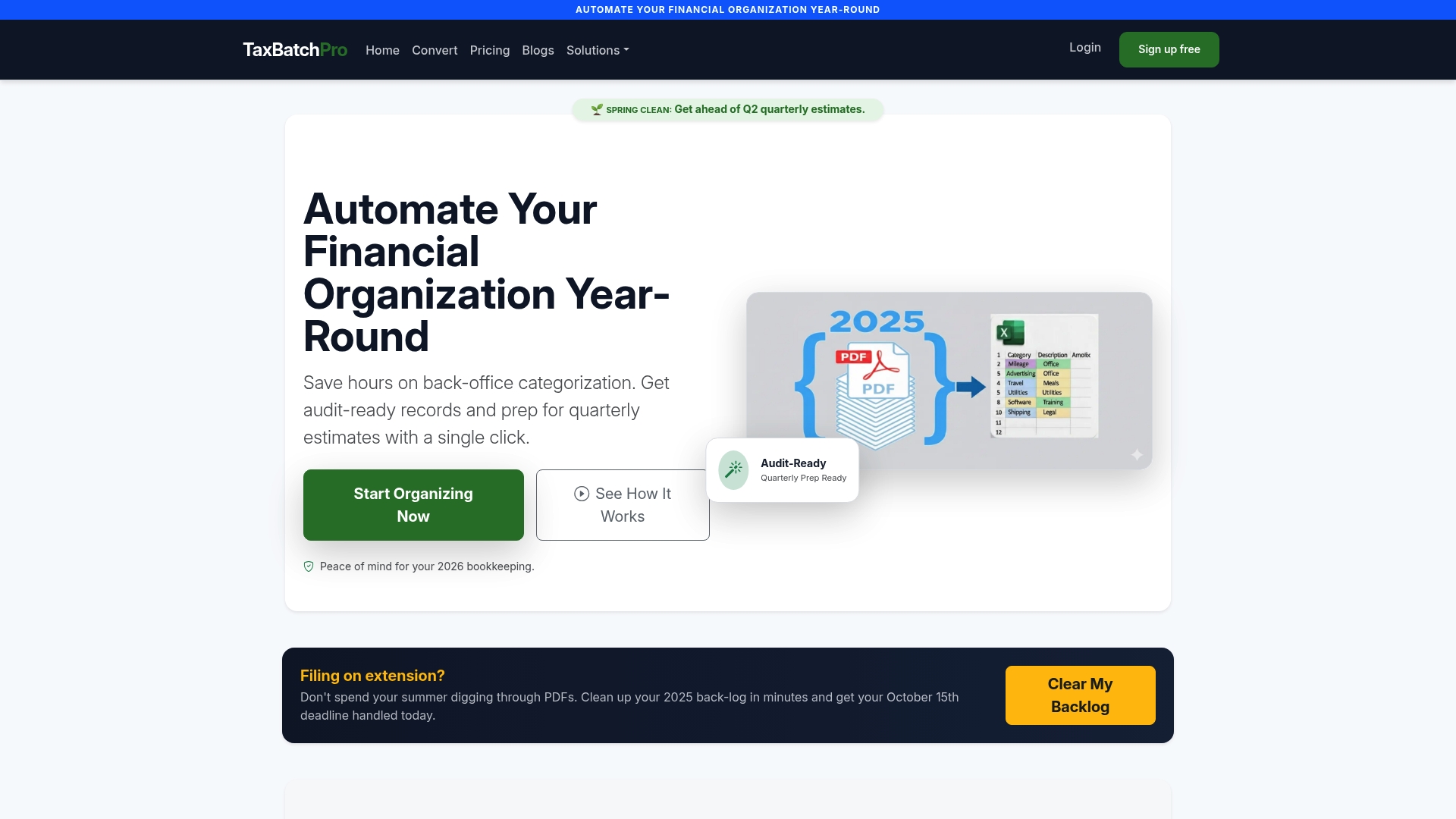
The platform converts scanned bank and credit card statement PDFs into structured, tax-ready Excel spreadsheets in under 90 seconds. Transactions are automatically mapped to IRS Schedule C categories, eliminating manual transcription and reducing the risk of misclassification. Freelancers and small business owners can process a full year of statements in a single batch upload, arriving at their year-end review with clean, organized data instead of a pile of PDFs. Use Taxbatchpro's IRS-ready conversion tool to get your statements audit-ready before your CPA review or filing deadline.
FAQ
What is a year-end tax prep checklist?
A year-end tax prep checklist is a structured list of financial tasks, document requirements, and deadlines that small business owners and freelancers complete before december 31 to ensure accurate filing and maximum deductions.
When should I start year-end tax planning?
Start in october. Beginning in early Q4 gives you 8–10 weeks to project income, execute tax-loss harvesting within the wash sale window, and finalize retirement contributions before hard deadlines close.
What documents do I need for year-end tax preparation?
You need W-2s, 1099s, bank and credit card statements, a profit and loss statement, payroll records, expense receipts, and your prior-year return. Federal tax forms for 2026 are issued by february 2, 2027.
What is the Solo 401(k) contribution deadline for 2026?
Employee contributions to a Solo 401(k) must be made by december 31, 2026, with a limit of $24,500 or $32,500 with catch-up. Employer contributions can be made up to the tax-filing deadline with extensions.
How do I avoid underpayment penalties as a freelancer?
Meet the IRS safe harbor threshold by paying either 90% of your current year's tax liability or 100% of your prior year's tax (110% for high earners) through withholding and estimated payments before the quarterly deadlines.