Why Bookkeeping Errors Trigger Audits: A Business Guide

Bookkeeping errors trigger audits by creating data discrepancies that IRS automated systems flag before a human examiner ever reviews your return. The IRS uses programs like the Automated Underreporter (AUR) and the Discriminant Information Function (DIF) to compare your filed numbers against third-party reports and statistical norms. When your books don't match what banks, employers, and vendors report, the system scores your return as high-risk. Understanding the mechanics behind this process is the first step toward keeping your business off the IRS's radar.
Why bookkeeping errors trigger audits
The IRS does not rely on guesswork to select returns for examination. Audit selection is mostly algorithmic, driven by discrepancies between your books, your tax filing, and third-party data sources. When those three data points don't align, the system flags your return automatically.
The most common bookkeeping mistakes that raise IRS red flags include:
- Math errors and typos. A transposed digit on Schedule C can make reported income appear lower than what third-party 1099s show. The AUR program catches this mismatch instantly.
- Inconsistent or missing income records. If a client files a 1099 for $15,000 paid to your business and you report $12,000, the gap triggers a discrepancy notice.
- Misclassified expenses and inflated deductions. Deductions exceeding industry norms by 20% or more increase audit frequency. Labeling a personal vacation as a "business travel" expense is a common example.
- Unreconciled bank and credit card statements. When your bank records don't match your general ledger, the inconsistency creates gaps that examiners notice immediately.
- Mixing personal and business finances. Commingling personal and business funds is the top audit trigger for small businesses. It also risks piercing corporate veil protections, which compounds legal exposure.
- Failing to issue or report 1099 forms. If you pay a contractor $1,200 and skip the 1099-NEC, the IRS may question whether other payments were also unreported.
- Excessive use of rounded numbers. Reporting every expense as $500, $1,000, or $2,500 signals estimation rather than actual recordkeeping.
- Late or year-end book adjustments. January and February adjustments to prior-year books raise IRS suspicion and undermine audit credibility.
Pro Tip: Keep a running transaction log throughout the year. Reconstructing 12 months of records in february before filing is exactly the kind of last-minute pattern that elevates your DIF score.
How does the IRS detect bookkeeping errors automatically?

The IRS uses three primary systems to identify returns worth examining. Each one targets a different type of bookkeeping failure.
| IRS System | What It Does | What It Catches |
|---|---|---|
| AUR (Automated Underreporter) | Matches filed income against W-2s, 1099s, and 1099-DA forms | Unreported income, missing 1099 income |
| DIF (Discriminant Information Function) | Scores returns against statistical norms for similar filers | Inflated deductions, unusual expense ratios |
| UIDIF (Unreported Income DIF) | Estimates unreported income based on lifestyle and asset indicators | Cash-heavy businesses, unexplained deposits |
The AUR program alone generated $7.7 billion in additional tax assessments in fiscal year 2024. That figure represents roughly 75% of all individual examinations. The scale of that number shows how effectively automated matching catches what manual review would miss.
The DIF score is particularly important for business owners to understand. It compares your deductions, income ratios, and expense categories against a statistical peer group of similar businesses. A score that deviates significantly from the norm triggers closer review.
"IRS audit selection uses a proprietary DIF score that penalizes deviations from peer statistical norms. Realistic, well-documented bookkeeping is the best defense, not chasing perfection." IRS Audit Triggers 2026
Third-party reporting forms expand IRS visibility every year. The new 1099-DA form for digital asset transactions means cryptocurrency activity now feeds directly into the AUR matching process. Emerging IRS forms like 1099-DA signal that the IRS is closing information gaps that previously allowed errors to go undetected. Consistent, reconciled records reduce your DIF score and lower the probability that AUR finds a mismatch worth flagging.
What bookkeeping practices reduce audit risk?
Reducing audit risk is not about making your books look good. It is about making them accurate, consistent, and fully documented. The following practices address the specific failure points that IRS systems target.
Reconcile accounts every month. Monthly reconciliation catches discrepancies before they compound. A single unreconciled month can cascade into a year-end gap that looks suspicious on a return.
Keep supporting documentation for every deduction. The IRS requires receipts, invoices, and clear transaction descriptions for all claimed deductions. A bank statement alone is not sufficient. Attach the vendor invoice and note the business purpose.
Separate personal and business finances completely. Open a dedicated business checking account and a business credit card. Never pay personal expenses from business accounts, even temporarily.
Use digital tools to reduce manual transcription errors. Digitizing invoices and receipts with document capture tools improves data integrity and reduces the manual entry errors that feed into AUR mismatches. Taxbatchpro, for example, converts bank and credit card statement PDFs into structured, IRS Schedule C-ready Excel spreadsheets, eliminating the transcription errors that create discrepancies between your books and your filing.
Classify expenses accurately and consistently. Use the same category labels throughout the year. Switching between "office supplies" and "miscellaneous" for the same type of purchase creates classification inconsistencies that inflate certain expense lines.
Issue and track 1099-NEC forms correctly. Any contractor paid $600 or more in a calendar year requires a 1099-NEC. Track contractor payments in real time rather than reconstructing them in january.
Avoid year-end bulk adjustments. Make corrections as errors occur. Bulk adjustments filed in the weeks before the tax deadline signal that your books were not maintained throughout the year.
Pro Tip: Schedule a quarterly "audit readiness review" with your accountant. Catching a misclassified expense in april is far less costly than explaining it during an IRS examination in the following year.
What are the real consequences of bookkeeping errors?
The financial cost of a bookkeeping-triggered audit extends well beyond the taxes owed. Penalties, interest, and professional fees accumulate quickly once an examination begins.
- Accuracy-related penalties. The IRS imposes a 20% penalty on underpayments attributable to negligence or disregard of rules. Poor recordkeeping qualifies as negligence under IRS guidelines.
- Interest on unpaid tax. Interest accrues from the original due date of the return, not the audit notice date. A two-year audit process means two years of compounding interest on any balance owed.
- Extended statute of limitations. IRS audit rates for high-income filers can reach 8.5%, with returns examined up to six years back when substantial errors exist. Clean books limit the IRS's ability to expand the audit scope.
- Professional fees. Tax attorneys and enrolled agents charge significant hourly rates. A correspondence audit resolved in weeks costs far less than a field audit lasting months.
- Reputational and operational disruption. An audit diverts management attention from operations. For small businesses, that distraction has a real cost in lost productivity and delayed decisions.
Most audit penalties stem from poor bookkeeping systems, not fraud. That distinction matters because it means the risk is preventable. Proactive monthly reconciliation stops the snowball effect where one missed entry compounds into a pattern that looks deliberate to an examiner. When your records are clean and complete, audits tend to resolve faster and with fewer adjustments.
Key Takeaways
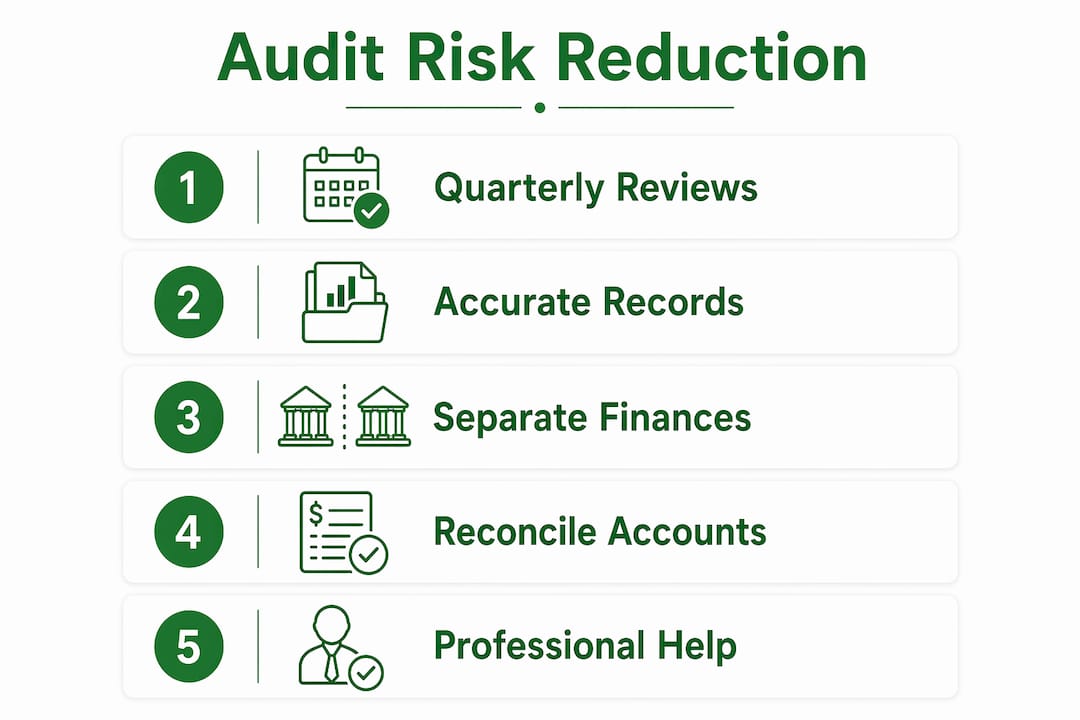
Bookkeeping errors trigger audits because they create measurable discrepancies that IRS automated systems like AUR and DIF score as high-risk before any human examiner reviews the return.
| Point | Details |
|---|---|
| AUR drives most examinations | The AUR program generated $7.7 billion in additional assessments in fiscal year 2024, covering roughly 75% of individual examinations. |
| DIF score penalizes outliers | Deductions exceeding industry norms by 20% or more raise your DIF score and increase the probability of selection. |
| Commingling funds is the top trigger | Mixing personal and business finances is the leading audit trigger for small businesses and risks corporate veil protections. |
| Monthly reconciliation prevents cascades | Catching discrepancies monthly stops single errors from compounding into year-end gaps that look suspicious on a return. |
| Clean records shorten audits | Complete documentation reduces penalty exposure and limits the IRS's ability to expand the audit scope to prior years. |
The bookkeeping control system most businesses ignore
Most business owners treat bookkeeping as a clerical task. That framing is the root cause of most audit problems I see.
The IRS's enforcement infrastructure is data-driven and largely automated. Your books are not just a record of what happened. They are the primary input into a scoring system that decides whether your return gets flagged. When you treat bookkeeping as a monthly chore rather than a continuous control function, you create the exact gaps that AUR and DIF are designed to find.
The businesses that consistently avoid audit scrutiny share one trait: they maintain their books the same way in january as they do in december. There is no year-end scramble, no bulk reclassification, and no reconstructed records. Their documentation exists at the transaction level, not the summary level.
Automation changes the calculus here in a meaningful way. AI-driven accounting workflows reduce the manual transcription errors that feed directly into AUR mismatches. The businesses I see adopting these tools are not just saving time. They are building a defensible audit trail that holds up under examination.
Bookkeeping accuracy also affects your business beyond taxes. Lenders, investors, and acquirers all rely on your financial records to assess creditworthiness and valuation. Clean, reconciled books signal operational discipline. Messy books signal risk, and that signal reaches further than the IRS.
— Ian
Taxbatchpro: audit-ready books without the manual work
Accurate books are your best defense against an IRS examination, and the fastest way to maintain accuracy is to remove manual data entry from the process entirely.

Taxbatchpro converts scanned bank and credit card statement PDFs into structured, tax-ready Excel spreadsheets in under 90 seconds. Transactions are automatically mapped to IRS Schedule C categories, eliminating the classification errors and transcription mistakes that raise DIF scores. For accountants managing multiple clients, the batch statement extraction feature processes an entire year of statements in a single upload. Business owners can use the free PDF converter to get IRS-ready records without hiring additional staff. Accurate data in, clean books out.
FAQ
What triggers an IRS audit most often?
The AUR program triggers the majority of IRS audits by matching your filed income against third-party reports like W-2s and 1099s. Discrepancies between those figures and your return generate an automatic flag.
How does mixing personal and business finances cause audit problems?
Commingled accounts make it impossible to clearly document which expenses are business-related, leading to deduction disallowance and increased scrutiny of all transactions in the account.
Can bookkeeping errors from prior years trigger a current audit?
Yes. The IRS can examine returns up to six years back when substantial errors exist, so poor recordkeeping in any recent year creates ongoing exposure.
Does the IRS penalize businesses for bookkeeping mistakes even without fraud?
The IRS imposes a 20% accuracy-related penalty on underpayments caused by negligence, which includes poor recordkeeping, regardless of fraudulent intent.
What is the fastest way to reduce audit risk?
Monthly account reconciliation combined with complete transaction-level documentation is the most direct way to lower your DIF score and reduce the probability of AUR flagging a mismatch.