What Is the Financial Close Process? A Practical Guide

The financial close process is defined as the formal, cyclical series of accounting procedures a company performs to finalize its books for a specific reporting period, typically monthly, quarterly, or annually. The goal is a single, authoritative version of financial truth reflected in the balance sheet and income statement. Every stakeholder, from management to auditors to regulators, depends on the output of this process. Under GAAP and SEC filing requirements, the close is not optional. It is the foundation of financial credibility.
What is the financial close process, step by step?
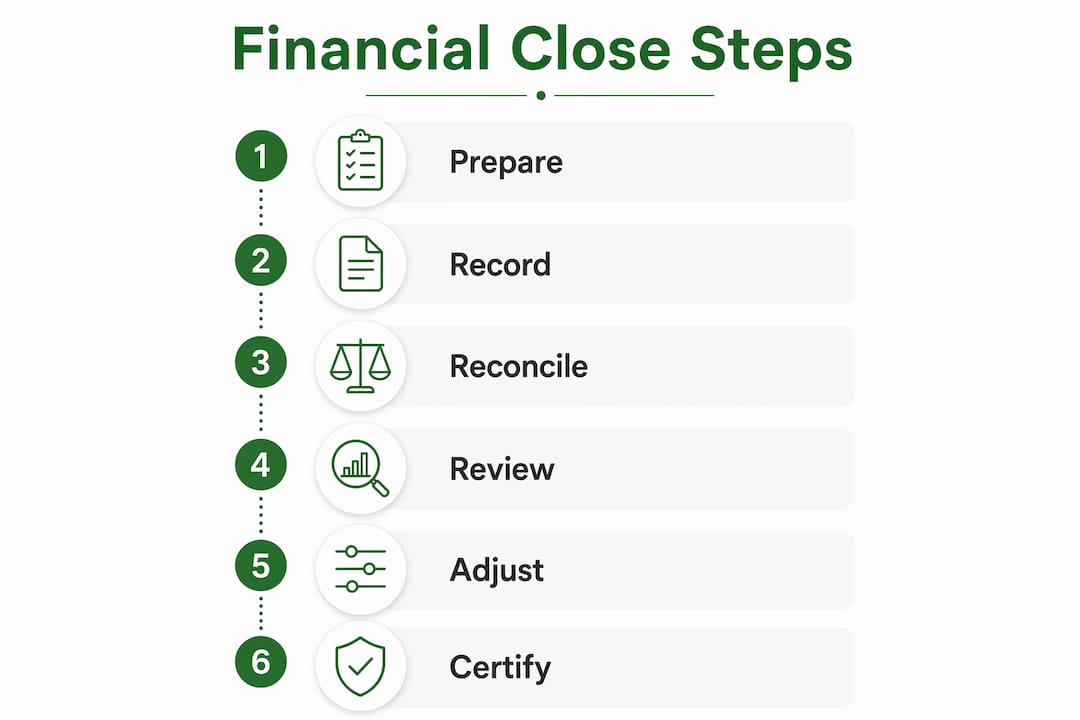
The financial close process follows a structured six-step lifecycle. Each step builds on the last, and skipping one creates compounding errors downstream.
Record transactions and enforce cutoff. Every transaction belonging to the period must be captured before the books close. Cutoff management prevents revenue or expenses from bleeding into the wrong period, which is one of the most common and costly errors in financial reporting.
Reconcile sub-ledgers to the general ledger. Accounts receivable, accounts payable, and inventory balances must tie exactly to the general ledger. Any discrepancy signals either a recording error or a missing transaction that must be resolved before moving forward.
Post adjusting journal entries. Accruals, deferrals, prepaid expenses, and depreciation all require adjusting entries. These entries reflect economic reality rather than just cash movement, which is the core principle behind accrual accounting under GAAP.
Consolidate multi-entity data. Organizations with subsidiaries or foreign operations must eliminate intercompany transactions and convert foreign-currency balances. This step is where multi-entity closes become significantly more complex and error-prone.
Complete management review and sign-off. A senior finance leader reviews the trial balance, key ratios, and variance explanations before approving the period. This control step catches errors that automated systems miss, particularly judgment-based estimates.
Lock the period and finalize reports. Once approved, the accounting period is locked to prevent further changes. Final financial statements, including the income statement, balance sheet, and cash flow statement, are then distributed to stakeholders.
Pro Tip: Attach supporting documentation directly to each journal entry at the time of posting. This practice builds an unbroken audit trail throughout the year and eliminates the frantic document search that typically precedes external audits.
Why does the financial close process matter for your business?

The financial close process produces the financial statements that every major business decision rests on. Cash flow forecasting, budget variances, and capital allocation all depend on numbers that are accurate and timely. A flawed close produces flawed inputs, and flawed inputs produce flawed strategy.
Compliance is the second major reason the close matters. Public companies face SEC filing deadlines, and private companies face lender covenants and tax obligations. Both require financial statements that meet GAAP standards. A poorly managed close creates restatement risk, which damages credibility with investors and regulators alike.
"A well-run financial close is the heartbeat of data governance. It does not just produce reports. It validates that the business's financial reality is accurately captured, making every downstream forecast and budget more reliable."
The close also functions as a fraud detection mechanism. Reconciliations and management review create checkpoints where unauthorized transactions, duplicate payments, or misclassified expenses surface. Finance teams that skip or rush these steps lose their best early-warning system. The importance of financial close extends well beyond bookkeeping. It directly shapes audit readiness, investor confidence, and the quality of every financial decision the business makes.
How can finance teams improve close efficiency and accuracy?
The most effective shift a finance team can make is moving from a batch month-end close to a continuous close model. Rolling reconciliations performed throughout the accounting period reduce the volume of work compressed into the final days of the month. The result is faster closes with fewer errors and less staff stress.
The following practices separate high-performing finance teams from those that struggle every month-end:
- Adopt a formal closing calendar. Assign a named owner to every close task with a specific due date. Clear task ownership eliminates the communication delays and manual data-gathering bottlenecks that cause most close delays.
- Automate transaction imports. Integrated ERP systems that pull bank and credit card data automatically reduce manual transcription errors at the source. Top organizations reduce manual close tasks by 30–50% using integrated ERP systems and continuous automated reconciliations.
- Maintain a governed financial close checklist. A checklist with sign-off fields creates accountability and ensures no step is skipped under deadline pressure. Treat it as a living document that updates when processes change.
- Enforce strict cutoff controls. Failing to enforce cutoff is the most frequent error in the close cycle. Transactions recorded in the wrong period require costly rework and can trigger audit findings.
- Prioritize data integrity over speed. Accuracy should never be sacrificed for a faster close date. Automation and early data validation reduce manual effort while preserving reliability.
Pro Tip: Use AI-powered document extraction to convert bank and credit card statement PDFs into structured data before the close begins. Clean inputs at the start of the process eliminate reconciliation surprises at the end.
The comparison below illustrates how two approaches to the close differ in practice:
| Criteria | Manual batch close | Continuous close model |
|---|---|---|
| Reconciliation timing | Month-end sprint | Throughout the period |
| Error detection | Late, under pressure | Early, with time to correct |
| Audit readiness | Assembled post-close | Maintained in real time |
| Staff workload | Compressed and high-stress | Distributed and manageable |
| Close cycle time | Longer | Shorter |
What are the most common challenges in the financial close?
Manual data gathering is the single biggest bottleneck in most close cycles. Finance teams spend hours pulling reports from disconnected systems, reconciling spreadsheets, and chasing department heads for expense data. That time is not spent on analysis. It is spent on data assembly.
The following challenges appear consistently across organizations of every size:
- Cutoff failures. Transactions recorded in the wrong period create misstatements that require restatement or audit adjustments.
- Spreadsheet errors. Manual spreadsheets introduce formula errors, version conflicts, and data integrity risks that compound over time.
- Fragmented systems. When payroll, expenses, and revenue live in separate platforms with no integration, reconciliation becomes a manual matching exercise prone to omissions.
- Multi-entity complexity. Consolidating subsidiaries with different charts of accounts or foreign-currency balances multiplies the risk of error at every step.
- Incomplete audit trails. Finance teams that do not attach supporting evidence to journal entries at posting time face time-consuming document searches during audits.
- Staff burnout. Compressing the entire close into three to five business days creates unsustainable pressure. High turnover in accounting roles often traces back to poor close process design.
Recognizing these challenges early allows finance leaders to redesign workflows before they become recurring crises. The financial close checklist is one of the most practical tools for surfacing gaps in the current process.
Key Takeaways
A well-executed financial close process requires continuous reconciliation, strict cutoff controls, named task ownership, and audit-ready documentation maintained throughout the reporting period, not just at month-end.
| Point | Details |
|---|---|
| Define the close clearly | The financial close is a formal six-step cycle ending in locked, auditable financial statements. |
| Enforce cutoff controls | Recording transactions in the wrong period is the most common and costly close error. |
| Adopt continuous reconciliation | Rolling reconciliations throughout the period reduce month-end errors and staff pressure. |
| Assign task ownership | A closing calendar with named owners eliminates communication delays and missed deadlines. |
| Maintain real-time documentation | Attaching evidence to journal entries at posting time makes audits routine rather than stressful. |
The close is a discipline, not a deadline
After working with finance teams across industries, the pattern is consistent. The organizations that struggle most with the close treat it as a monthly deadline to survive. The organizations that excel treat it as a continuous discipline built into daily operations.
The mindset shift matters more than the technology. A team that reconciles accounts weekly, enforces cutoff daily, and attaches documentation at the time of posting will outperform a team with better software but no process discipline. I have seen companies invest in enterprise ERP platforms and still close in ten days because the underlying habits were never changed.
The concept of certifying books rather than just closing them is the most useful reframe I have encountered. Certification implies validation, evidence, and accountability. Closing implies finishing and moving on. The former produces audit-ready financials year-round. The latter produces a recurring scramble.
Speed and accuracy are not in conflict when the process is designed correctly. Clean data inputs, governed workflows, and real-time documentation make a faster close the natural outcome of a well-run operation. The finance teams that invest in data quality practices early in the period never face the reconciliation crises that define a poorly managed close.
The close is also where finance earns its seat at the strategy table. When the numbers are reliable and available on time, management can make decisions with confidence. When the close is chaotic, finance becomes a bottleneck rather than a business partner.
— Ian
How Taxbatchpro supports a faster, cleaner financial close
Finance teams lose significant time at the start of every close cycle manually entering bank and credit card transaction data. Taxbatchpro eliminates that bottleneck by converting scanned statement PDFs into structured, IRS-ready Excel spreadsheets in under 90 seconds.
Clean transaction data at the start of the close cycle means fewer reconciliation errors, tighter cutoff controls, and less time spent correcting mismatches before the period locks. Taxbatchpro's batch upload capability handles a full year of statements in a single session, automatically mapping transactions to IRS Schedule C categories. For accounting professionals managing multiple clients, the statement extraction platform reduces manual transcription risk and keeps every engagement audit-ready. Start with a free PDF conversion to see how clean inputs change the close experience.
FAQ
What is the financial close process in simple terms?
The financial close process is the set of accounting steps a company follows to finalize its books for a reporting period. It ends with locked, auditable financial statements ready for stakeholders and regulators.
How long does a typical financial close take?
Close cycle length varies by organization size and process maturity. Companies using continuous reconciliation and automated data imports typically close faster than those relying on manual, batch-style processes.
What is the most common mistake in the financial close?
Failing to enforce cutoff controls is the most frequent error. Transactions recorded in the wrong period create misstatements that require costly rework and can trigger audit findings.
What is a financial close checklist?
A financial close checklist is a governed list of every task required to complete the close, with assigned owners and due dates. It creates accountability and prevents steps from being skipped under deadline pressure.
How does automation improve the financial close process?
Automation reduces manual data entry, enforces consistent reconciliation workflows, and maintains real-time audit trails. Organizations using integrated systems reduce manual close tasks substantially compared to teams relying on spreadsheets.