The Full List of 1099 Expense Categories the IRS Lets You Deduct

Self-employed taxpayers can deduct business costs across roughly a dozen recognized categories, including home office, vehicle mileage, supplies, contract labor, insurance, and advertising, provided each expense passes the IRS "ordinary and necessary" test under Schedule C. Most of these categories map directly to specific lines on Schedule C (Form 1040), which means the classification you choose now determines exactly where the number lands come filing season..
Two things separate a clean 1099 return from one that invites a second look. First, a handful of deductions live above the line on Form 1040 rather than on Schedule C itself, including your self-employed health insurance premiums and half of your self-employment tax. Second, every dollar you claim needs to trace back to a category and a document, because the IRS doesn't take your word for it.
- Above-the-line deductions (health insurance, half of SE tax) reduce your adjusted gross income separately from Schedule C profit.
- Every expense category should map to a specific Schedule C line before you file, not after an IRS notice arrives.
Quick reference: The IRS sets a standard mileage rate each year for business driving, updated annually and worth checking before you log your first trip of 2026. For lodging and meals on the road, GSA per diem tables give you a locality-specific benchmark instead of guessing what's "reasonable."
Key Takeaways
Accurate 1099 expense categorization depends on matching every deduction to its correct Schedule C line, documenting it consistently, and tracking totals monthly rather than reconstructing them at filing time.
| Point | Details |
|---|---|
| Know your categories | Home office, vehicle, supplies, contract labor, insurance, and advertising each map to a specific Schedule C line. |
| Apply the ordinary-and-necessary test | Every deduction must be common in your trade and appropriate for your business to survive review. |
| Use the current mileage rate | Check the IRS standard mileage rate annually rather than assuming last year's figure still applies. |
| Categorize monthly, not annually | Monthly reconciliation produces accurate estimated tax calculations and catches missing receipts early. |
| Automate statement extraction | Taxbatchpro converts scanned bank and credit card statements into categorized, audit-ready Excel files mapped to Schedule C. |
This article is general information, not a substitute for advice from a qualified financial advisor. Consult a qualified financial professional about your own circumstances before acting on anything here.
Table of Contents
- Complete 1099 Expense Categories Breakdown by Type
- Mapping 1099 Deductions to the Right Schedule C Line
- Building a Recordkeeping System That Survives an Audit
- Common 1099 Filing Mistakes That Trigger IRS Attention
- How Automated Statement Extraction Speeds Accurate Expense Classification
- Freelancers vs. Contractors: Do Expense Categories Differ?
- Why Expense Categorization Affects Your Estimated Tax Payments
- Choosing the Right Tool to Track 1099 Business Expenses
- What Consistent Categorization Habits Actually Change
- Turn Statement Sorting Into a 90-Second Task
- Sources
Complete 1099 Expense Categories Breakdown by Type
Knowing that a category exists is only half the job. The IRS wants to see that each expense was ordinary (common in your line of work) and necessary (helpful and appropriate for your business), a standard drawn directly from Schedule C guidance. Here's what that test looks like in practice, category by category.
Home office
You can deduct home office costs using the simplified method or the regular method, and the two produce very different numbers. The simplified method lets you claim $5 per square foot of dedicated office space, up to 300 square feet, with no depreciation calculation required. The regular method requires Form 8829 and lets you deduct a percentage of your actual home costs, mortgage interest or rent, utilities, insurance, and depreciation, based on the share of your home used exclusively for business.
That word "exclusively" trips up more filers than any other home office rule. A guest bedroom that doubles as an office three days a week and a nursery the other four doesn't qualify. A closet-turned-desk-nook that never sees personal use does.
How to document it: Keep a floor plan or square footage measurement, a photo of the space, and your utility and mortgage statements if using the regular method.
Vehicle and mileage
You can deduct business driving with the IRS standard mileage rate or by tracking actual expenses (gas, insurance, repairs, depreciation) and applying your business-use percentage. The standard mileage rate is simpler for most 1099 filers, but the IRS still expects contemporaneous records, not a number you reconstructed in March.

A compliant mileage log needs four fields for every trip: date, starting and ending odometer readings (or total miles), destination, and business purpose. Parking fees and tolls are 100% deductible on top of whichever mileage method you choose. If you drive a lot for a single client or bounce between multiple job sites, actual expenses sometimes beat the standard rate, particularly for a newer vehicle with high loan interest or heavy depreciation.
How to document it: A mileage log app or spreadsheet updated weekly, plus toll and parking receipts filed by month.
Supplies, equipment, and depreciation
Everyday consumables, paper, ink, small tools, cleaning supplies, get expensed immediately as supplies. Larger purchases like a laptop, camera, or specialized equipment usually count as capital assets, which the IRS wants depreciated over several years, unless you elect Section 179 to deduct the full cost in the year you bought it.
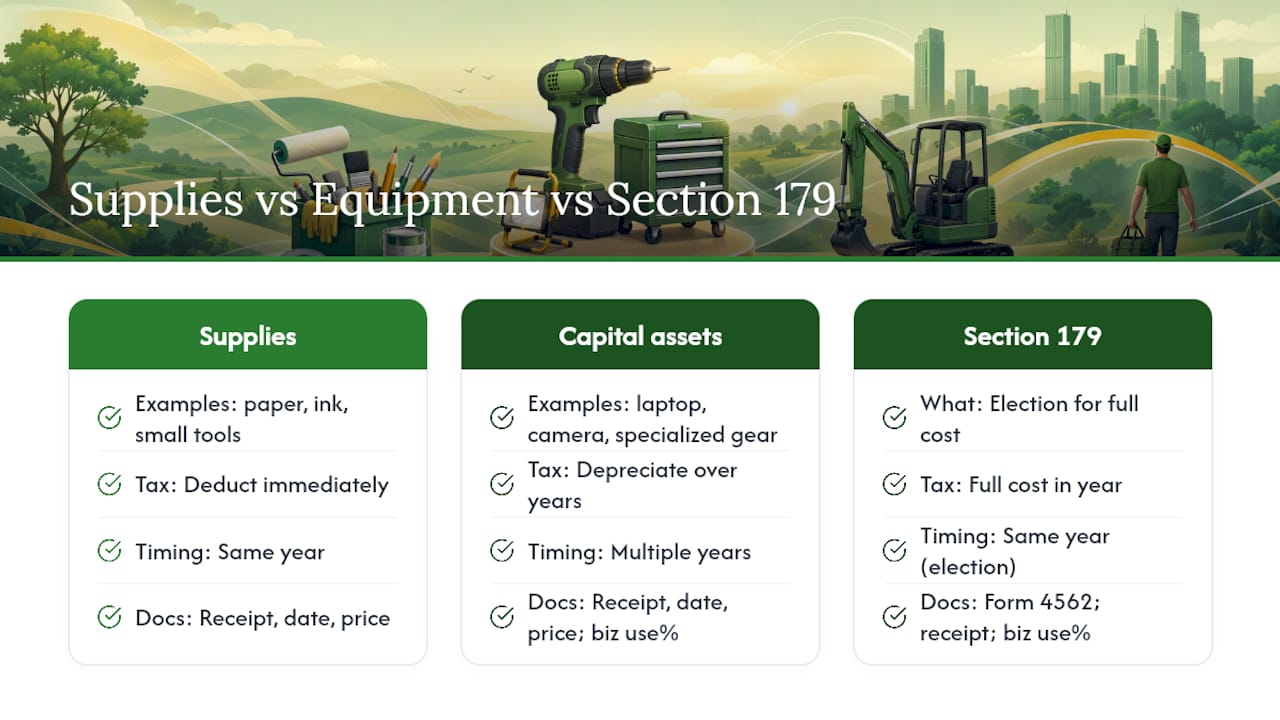
Section 179 exists precisely so a freelance photographer doesn't have to spread a $2,000 camera body across five tax returns. Form 4562 is where that election gets made, and it interacts directly with your Schedule C profit calculation.
How to document it: Save the purchase receipt showing date, item, and price, and note the percentage of business use if the item also serves personal purposes.
Contract labor and 1099-NEC
If you paid another independent contractor $600 or more for services during the year, you're generally required to issue them a Form 1099-NEC. Those payments get deducted on Schedule C, Line 11 as contract labor, separate from any employee wages you might report elsewhere.
This is one of the more common compliance gaps among solo operators who hire subcontractors informally. If you're the one classifying workers rather than issuing 1099s, the distinction between an employee and a contractor matters for more than taxes. A payroll classification guide is worth reading before you assume a working relationship qualifies as contract labor rather than employment.
How to document it: Copies of every 1099-NEC issued, W-9 forms collected from contractors before payment, and invoices matching each payment.
Meals and travel
Travel and meals are two different categories with two different rules, and conflating them is a common filing error. Business travel, airfare, lodging, ground transportation, is generally fully deductible when the trip is primarily for business, according to IRS Publication 463. Business meals, by contrast, are typically limited to a 50% deduction, whether that's a client lunch or food purchased while traveling overnight for work.
If you'd rather not save every meal receipt on a multi-day trip, GSA per diem rates offer a locality-based daily allowance for lodging and meals that many self-employed filers use as a documentation shortcut, especially useful if you travel to the same handful of cities repeatedly.
How to document it: Itemized receipts noting who you met with and the business purpose, or a per diem log citing the GSA locality rate you applied.
Insurance and retirement contributions
Business insurance, general liability, professional liability, or a business owner's policy, is deducted as a regular business expense on Schedule C. Self-employed health insurance premiums work differently: they're claimed as an above-the-line deduction on Form 1040, not on Schedule C, and the amount is capped at your net self-employment income. Retirement contributions to a SEP-IRA or Solo 401(k) follow a similar above-the-line path rather than reducing your Schedule C profit directly.
How to document it: Annual insurance premium statements and retirement plan contribution confirmations from your provider.
Advertising, marketing, and software subscriptions
Website hosting, paid ads, business cards, and marketing consultants land on Schedule C, Line 8 as advertising. Software subscriptions, accounting tools, design programs, project management platforms, get deducted based on the percentage used for business, which matters if you're running the same laptop and the same Adobe subscription for client work and family photos.
How to document it: Monthly subscription statements or annual invoices, with a note on business-use percentage for any shared-use software.
Other common categories
A handful of smaller categories round out most 1099 filers' deductions:
- Licensing and permits — professional licenses, local business permits, and certification renewal fees.
- Bank and payment processing fees — monthly account fees, wire fees, and card processing charges tied to business banking.
- Professional dues and subscriptions — trade association memberships and industry publication subscriptions.
- Business gifts — deductible up to $25 per recipient per year, a limit that surprises most people the first time they hit it.
- Continuing education — courses and certifications that maintain or improve skills in your existing trade, not training for a brand-new field.
- Legal and professional fees — payments to a CPA, bookkeeper, or attorney for business-related services.
Pro Tip: Keep a running digital folder by month, not by category. When tax time comes, sorting twelve months of receipts into categories is far faster than hunting through a year's worth of scattered statements for "office supplies."
Mapping 1099 Deductions to the Right Schedule C Line
The IRS's ordinary-and-necessary standard, laid out in guidance tied to Schedule C, asks two questions of every expense: is it common in your trade, and is it helpful and appropriate for running your business? An expense can be perfectly legitimate and still get flagged if it's parked on the wrong line, because mismatched categories are one of the easier things for a reviewer to spot on a return.
Schedule C organizes deductible expenses across lines 8 through 27, with Part V reserved for itemizing "other expenses" that don't fit a predefined line. A rough guide to where common 1099 expenses land:
- Line 8 — Advertising (website costs, paid promotions, business cards)
- Line 9 — Car and truck expenses (mileage or actual vehicle costs)
- Line 11 — Contract labor (payments to subcontractors requiring a 1099-NEC)
- Line 15 — Insurance (business liability, not health insurance)
- Line 17 — Legal and professional services (CPA, attorney, bookkeeper fees)
- Line 18 — Office expense (supplies, small equipment, some software)
- Line 20 — Rent or lease (office space, equipment rentals)
- Line 22 — Supplies
- Line 24b — Meals (subject to the 50% limit)
- Line 25 — Utilities (business-use portion of phone, internet, electricity)
- Line 27a — Other expenses (detailed in Part V: dues, subscriptions, bank fees)
Self-employed health insurance and half of your self-employment tax skip Schedule C entirely. Both are above-the-line adjustments on Form 1040, which lowers your adjusted gross income rather than your Schedule C net profit. That distinction affects more than aesthetics. Your Schedule C profit feeds into your self-employment tax calculation, while the above-the-line deductions apply after that calculation is done.
Depreciation and Section 179 elections get calculated on Form 4562 first, then the resulting deduction flows back to Schedule C Line 13. If you're claiming the home office deduction under the regular method, Form 8829 performs a similar handoff, calculating your allowable home expense percentage before it lands on Schedule C Line 30. A Schedule C mapping walkthrough can help if you're categorizing a full year of transactions and want to confirm each one before you file.
Building a Recordkeeping System That Survives an Audit
The IRS doesn't require exotic recordkeeping, but it does require consistency. At minimum, keep receipts and invoices for every deduction, bank and credit card statements covering the full tax year, and a mileage log with date, mileage, destination, and business purpose recorded close to the time of travel, not reconstructed months later.
A workable monthly rhythm looks like this:
- Capture every receipt and invoice as it happens, ideally photographed or saved digitally the same week.
- Categorize each transaction into its Schedule C category before the month closes, while the context is still fresh.
- Reconcile your categorized totals against your bank and credit card statements to catch anything missed or duplicated.
By year-end, that monthly habit produces a categorized spreadsheet with running totals by Schedule C line, exactly what you or your preparer needs to fill out the actual form without a week of frantic sorting in April.
Retain your records for at least three years from the date you file, longer if you underreported income or claimed a loss, since the IRS's lookback window extends in those situations. If a receipt goes missing, a bank or credit card statement showing the charge, paired with a contemporaneous note about what it was for, is generally accepted as reconstructed documentation, though it's a weaker substitute for the original.
Pro Tip: Reconcile monthly, not annually. A missing receipt from January is easy to track down in February. It's nearly impossible to reconstruct in the following March.
Manually sorting a year of bank statements into categories is tedious work, and it's also where automation tends to pay off fastest, since software that maps transactions to Schedule C categories directly cuts out the guesswork of "was this office supplies or equipment?" for every single line item. For a deeper walkthrough of building this system by hand first, see this guide to organizing business expenses for tax time.
Common 1099 Filing Mistakes That Trigger IRS Attention
Certain errors show up often enough among 1099 filers that they're worth flagging before you make them yourself. Misallocating personal expenses as business costs, especially on a shared vehicle or shared phone plan, is the most frequent one. Failing to issue a required 1099-NEC to a subcontractor you paid $600 or more is another, since that gap creates a mismatch the IRS can flag on the other end. Overstated meal or mileage claims round out the top three, usually the result of estimating at year-end instead of logging as you go.
A few patterns tend to draw closer scrutiny:
- A home office deduction claimed without supporting square footage or exclusive-use documentation.
- A dramatic year-over-year swing in reported expenses relative to income, with no clear explanation.
- Meal or entertainment claims that look disproportionate to the size and nature of the business.
If you discover an error after filing, an amended return corrects it, and documenting exactly what changed and why protects you if questions come up later. For anything beyond a simple correction, particularly if depreciation, home office calculations, or multiple income streams are involved, a CPA is worth the consultation fee before you file the amendment yourself.
Before you submit your return, run through a short checklist: every category matches its correct Schedule C line, every 1099-NEC obligation has been met, mileage and meal logs exist for every claimed trip, and no personal expense has slipped into a business category. A self-employed tax prep checklist built specifically for freelancers can help you confirm nothing's been missed.
How Automated Statement Extraction Speeds Accurate Expense Classification
Manually transcribing a year of bank and credit card statements into Schedule C categories is where most classification errors originate, not from a lack of knowledge, but from fatigue after the fortieth page of PDF statements. Batch PDF extraction tools solve the specific bottleneck of converting scanned statements into structured, categorized data without retyping every line by hand.
- Bulk upload processes a full year of statements at once instead of month by month.
- Automated mapping assigns each transaction to a Schedule C category, reducing the manual guesswork on mixed-use card charges.
- Export produces an audit-ready spreadsheet formatted for tax preparation, not a raw transaction dump.
Automating the mapping of bank and credit card transactions to Schedule C categories reduces classification errors and produces audit-ready exports faster than sorting every line manually, particularly for anyone reconciling a full year of mixed-use spending at once.
Taxbatchpro was built around exactly this bottleneck: converting scanned statement PDFs into structured, categorized Excel files at scale. For readers who want to see the mapping logic applied to their own accounts, the Schedule C mapping guide walks through the same categories covered above, applied to real transaction data.
Freelancers vs. Contractors: Do Expense Categories Differ?
The IRS doesn't distinguish "freelancer" from "independent contractor" as separate tax categories. Both file Schedule C and both use the same expense categories described above. The differences that show up in practice come from the nature of the work, not the label.
A contractor working consistently for one or two clients, a driver, a delivery worker, a construction subcontractor, tends to lean heavily on vehicle expenses, tools and equipment, and possibly a home office if administrative work happens there. A freelancer juggling multiple clients across creative or consulting work often shows a broader spread: software subscriptions, marketing and advertising, professional development, and a higher proportion of home office use since the work itself is desk-based.
Where the categories genuinely diverge is in relative weight, not existence. A freelance graphic designer might claim minimal vehicle expenses and a substantial software and subscription line. A contractor doing on-site trade work might show the reverse, heavy vehicle and equipment deductions with little to no advertising spend. Neither filer skips a category that doesn't apply, they simply report zero or minimal amounts there and concentrate documentation on the categories that reflect how the business actually operates.
Why Expense Categorization Affects Your Estimated Tax Payments
Your Schedule C profit, income minus deductible expenses, is the number that drives your quarterly estimated tax calculation. Underestimate your deductions early in the year and you risk overpaying estimated taxes for months. Overestimate them and you risk an underpayment penalty when the final numbers come in short.
This is where categorization timing matters more than most 1099 filers realize. If you're only sorting expenses once a year at filing time, your quarterly estimates are essentially guesses based on gross income, not actual profit. Filers who categorize monthly get a running, accurate picture of net profit throughout the year, which makes each quarterly estimate a calculation instead of a guess.
Large deductions that hit unevenly, a big equipment purchase in Q2, a Section 179 election, or a spike in contract labor payments, can shift your effective tax rate for the year in ways that are easy to miss if you're not tracking categorized totals in real time. Filers who wait until April to categorize a full year of expenses often discover they've either overpaid four quarters running or underpaid enough to trigger a penalty, both avoidable with a running categorized total. Keeping your books current isn't just a recordkeeping preference, it's the input your quarterly tax math depends on.
Choosing the Right Tool to Track 1099 Business Expenses
Spreadsheets work for filers with straightforward, low-volume expenses. A basic monthly tab tracking category, amount, and date covers a freelancer with a handful of recurring costs and one or two income sources. The limitation shows up at volume: once you're reconciling hundreds of transactions across multiple bank and credit card accounts, manual entry becomes the slowest and most error-prone part of tax prep.
General accounting software (the kind built for ongoing bookkeeping rather than a once-a-year tax push) offers more structure, recurring category rules, bank feed imports, and running profit-and-loss reports. That's a reasonable fit for a contractor running a more complex operation year-round. But for filers whose real bottleneck is a stack of scanned PDF statements that need to become structured, categorized data fast, statement-extraction tools built specifically for that conversion step close a gap general bookkeeping software doesn't address directly.
The right tool depends on what's actually slowing you down. If it's inconsistent categorization across a year of statements, an extraction and mapping tool solves that specific problem. If it's ongoing invoicing and cash flow tracking, broader accounting software fits better. Most self-employed filers end up using some combination of the two, a bookkeeping system for day-to-day tracking and a faster extraction step when a full year of statements needs to become tax-ready numbers quickly.
What Consistent Categorization Habits Actually Change
The clients who consistently claim every deduction they're entitled to aren't the ones with the most complicated tax situations. They're the ones who categorize expenses the month they happen, not the week before filing. That single habit shift, moving from an annual scramble to a monthly rhythm, shows up repeatedly across self-employed filers regardless of industry or income level.
The pattern that costs people money isn't ignorance of what qualifies as deductible. It's the friction of sorting a year's worth of transactions retroactively, which leads to rushed guesses, missed receipts, and categories left blank because nobody could remember what a charge from eight months ago was actually for. If your situation involves multiple income streams, significant home office use, or a recent equipment purchase under Section 179, a CPA consultation is worth the cost before you file rather than after. For readers ready to build a monthly system rather than an annual one, the ordinary-and-necessary expense guide is a solid next stop.
— Ian
Turn Statement Sorting Into a 90-Second Task
Taxbatchpro exists for the exact bottleneck this article just walked through: converting a stack of scanned bank and credit card statements into categorized, Schedule C-ready numbers without the manual sorting. Instead of hand-entering a year of transactions into a spreadsheet, you upload the PDFs in batch and get back structured Excel files with each transaction mapped to its expense category, ready for your preparer or your own filing.
For accountants and bookkeepers handling this work across multiple clients, the accountant-focused workflow is built around the same batch-upload structure at firm scale. If you want to see the output before committing to anything, the free PDF-to-Excel converter lets you run a single statement through the tool and review the categorized result firsthand. Either way, the step that used to eat a weekend now takes under two minutes.
Sources
- About Schedule C (Form 1040), Profit or Loss From Business (Sole Proprietorship) | Internal Revenue Service
- Standard Mileage Rates | Internal Revenue Service
- Per Diem Rates | U.S. General Services Administration