What Counts as a Business Expense? The Ordinary-and-Necessary Test

A cost counts as a business expense when it is both ordinary and necessary for carrying on your trade or business, the two-part test written into 26 U.S.C. §162. "Ordinary" means the cost is common and accepted in your line of work. "Necessary" means it is helpful and appropriate for your business, not that you couldn't survive without it. If a purchase clears both bars, you can generally deduct it. If it doesn't, the IRS treats it as a personal, living, or family expense, and those are explicitly off the table no matter how you paid for them.
Here's what that looks like in practice. These are clearly deductible when tied to your trade or business:
- Rent for an office, studio, or retail space
- Wages, salaries, and contractor payments
- Supplies consumed in operations (paper, packaging, raw materials)
- Ordinary business travel, including airfare and lodging for a work trip
And these are not, full stop, regardless of which account paid for them:
- Your personal grocery bill
- A family vacation with no business purpose
- Commuting from home to your regular workplace
- Clothing you'd wear outside of work anyway
Pro Tip: Start today with one habit: every time you spend business money, write the date, amount, and a one-line business purpose on the receipt or in your accounting app. That single sentence is often the difference between a deduction that survives an audit and one that gets disallowed.
Key Takeaways
A cost qualifies as a business expense only when it is ordinary and necessary for your trade or business under IRC §162, and personal expenses stay nondeductible regardless of which account pays for them.
| Point | Details |
|---|---|
| The core legal test | An expense must be ordinary (common in your trade) and necessary (helpful and appropriate) to be deductible under §162. |
| Most common categories | Rent, wages, supplies, advertising, insurance, professional fees, and business travel cover the bulk of small business deductions. |
| Documentation that matters most | Keep receipts, bank statements, mileage logs, and a written business purpose for every mixed-use or unusual expense. |
| First step to take today | Reconcile last month's bank statement and write a one-line business purpose next to any unclear transaction. |
| Automate the paperwork | Taxbatchpro converts scanned bank and credit card statements into Schedule C-mapped spreadsheets to keep records audit-ready. |
Primary sources and further reading
- 26 U.S.C. §162, Trade or business expenses, the statutory text behind the ordinary-and-necessary test.
- IRS Publication 335 (Business Expenses) overview page, covering capitalization, depreciation, and deduction limits.
- Publication 334, Tax Guide for Small Business, for category-by-category examples relevant to sole proprietors.
- IRS guide to business expense resources, which links out to Schedule C instructions, Form 4562, and related worksheets.
- Standard mileage rates page, updated annually for vehicle expense calculations.
Use these pages to confirm current-year figures, download the actual forms, and find worked examples before you file. This article is general information, not personalized tax or legal advice; confirm current rules with these primary sources or a qualified tax professional for your specific situation.
Table of Contents
- What Counts as a Business Expense Under IRC §162?
- Which Expenses Are Deductible for Small Businesses?
- When Should You Depreciate Instead of Deduct?
- How Do You Allocate Mixed-Use Business Expenses?
- What Records Do You Need to Prove a Business Expense?
- How Do Accountable Plans and Reimbursements Affect Deductions?
- Where Do You Report Business Expenses on Your Tax Return?
- What Common Mistakes Trigger IRS Audits?
- A Quick Checklist to Decide If Something Is a Business Expense
- Turn Bank Statements Into Audit-Ready Records in Minutes
- Frequently Asked Questions
- Sources
What Counts as a Business Expense Under IRC §162?
The legal foundation for every deduction on your tax return traces back to one sentence in the tax code. Section 162 allows a deduction for "all the ordinary and necessary expenses paid or incurred during the taxable year in carrying on any trade or business." That's the entire statutory test, and it applies whether you run a solo consulting practice or a 40-person manufacturing shop.
The IRS does not maintain a master list of approved deductions. Instead, taxpayers apply the ordinary-and-necessary standard to their own facts and industry, which means the same expense can be deductible for one business and questionable for another.
A graphic designer buying a $3,000 drawing tablet is an ordinary expense in that trade. A bookkeeper buying the same tablet would need a much stronger justification, because it isn't common in that line of work. That's the "ordinary" half of the test working as intended, according to the Legal Information Institute's explanation of business expense law.
"Necessary" is the more forgiving half. Courts and the IRS have long interpreted it to mean helpful and appropriate, not indispensable. You don't have to prove your business would collapse without the expense. A marketing consultant doesn't need to prove that a $200 client dinner was the only way to close a deal, only that it was appropriate for maintaining a business relationship.
Mixed-purpose expenses complicate things, and the IRS addresses this directly. When a cost serves both a business and a personal function, such as a phone plan or a vehicle, the IRS's own guidance on income and expenses makes clear that you must divide the cost between business and personal use and can only deduct the business-use portion. There's no shortcut here: the burden is on you to establish and document a reasonable allocation method.
Pro Tip: When you write a business purpose in your records, be specific about what the expense accomplished, not just what it was. "Client dinner" is weak. "Dinner with Acme Corp procurement lead to discuss Q1 contract renewal" holds up far better if the IRS ever asks.
Which Expenses Are Deductible for Small Businesses?
Most small business deductions fall into a short list of recurring categories. Knowing them cold saves you from second-guessing every transaction that crosses your bank statement.
- Rent and lease payments for office, warehouse, or retail space
- Wages, salaries, and independent contractor fees
- Supplies and materials consumed in the ordinary course of business
- Advertising and marketing costs, including website development for SaaS companies and paid ads
- Business insurance premiums (liability, property, professional)
- Professional fees paid to accountants, attorneys, and consultants
- Utilities tied to a business location
- Interest on business loans and bank fees on business accounts
A very large number of small businesses operate in the United States, and nearly all of them touch several of these categories every single month, which is exactly why the IRS built dedicated publications around them rather than leaving owners to guess. Publication 334, the IRS's Tax Guide for Small Business, walks through these categories with examples specific to sole proprietors.
Travel and meals get their own set of rules. Business travel, including transportation, lodging, and incidentals for a trip primarily for business, is generally fully deductible. Business meals are typically only 50% deductible, even when the meal is legitimately tied to client work. IRS Publication 535 lays out the mechanics of this limit and the recordkeeping the IRS expects to support it.
Business gifts carry a stricter cap: $25 per recipient per year. Give a client a $75 gift basket, and you can only deduct $25 of it. This is a narrow rule, and it's worth distinguishing a gift (a tangible item given without expectation of immediate service) from entertainment, which changed dramatically after the Tax Cuts and Jobs Act. Entertainment expenses, think concert tickets or a round of golf with a prospect, are now nondeductible in almost all circumstances, even though the meal portion of a client outing may still qualify.
Personal living expenses stay nondeductible no matter how you frame them. Your commute from home to your regular office doesn't count, even if you'd argue it's "necessary" to get to work. The IRS treats commuting as inherently personal.
When Should You Depreciate Instead of Deduct?
Not every business purchase gets written off immediately, and this is where a lot of small business owners trip up. A capital expense is a cost for something that provides value beyond the current tax year, like equipment, a vehicle, or a building improvement. An ordinary expense is consumed within the year, like office supplies or a software subscription. The distinction matters because capital expenses generally have to be depreciated over time rather than deducted all at once.
Here's a simple way to think through it:
- Ask whether the item will still be useful to your business more than one year from now.
- If yes, it's typically a capital asset that must be capitalized and depreciated rather than expensed immediately, subject to some exceptions.
- Check whether Section 179 or bonus depreciation lets you deduct the full cost in the first year anyway.
- Report the deduction on Form 4562, Depreciation and Amortization, which flows through to your Schedule C or business return.
Section 179 exists precisely because Congress recognized that forcing every small business to depreciate a $2,000 laptop over five years is impractical. It lets qualifying businesses elect to deduct the full cost of eligible equipment in the year it's placed in service, up to an annual limit, instead of spreading it out. Bonus depreciation works similarly but with different eligibility rules and phase-out schedules. Publication 535 explains both elections and how they interact.
The business-use portion is $4,800. Under Section 179, that $4,800 could potentially be deducted in full in the purchase year rather than depreciated over the camera's useful life, assuming the photographer has enough business income to support the election and files Form 4562 to claim it.
- Everyday supplies (paper, ink, small tools) are typically deducted in full the year you buy them.
- Equipment, vehicles, and property improvements are typically capitalized and depreciated, unless Section 179 or bonus depreciation applies.
- Business-use percentage always determines the deductible portion, whether you're expensing or depreciating.
How Do You Allocate Mixed-Use Business Expenses?
Some of the trickiest calls in small business tax prep involve expenses that serve both your business and your personal life. Home offices, vehicles, and shared subscriptions all fall into this bucket, and the Legal Information Institute notes that mixed expenses are often only partially deductible based on documented business use.
The governing principle is simple even when the math isn't: split the cost by actual business use and keep a record of how you calculated that split. A reasonable, documented methodology, whether it's a time log, square footage, or mileage record, is what auditors look for, and the IRS itself recommends dividing mixed expenses rather than deducting them in full.
For a home office, the space must be used regularly and exclusively for business to qualify at all. That exclusivity requirement trips up a lot of owners who use the kitchen table for work three days a week; it doesn't meet the standard. Once you clear that hurdle, you can use the simplified method (a flat rate per square foot, capped at 300 square feet) or the regular method, which requires calculating the percentage of your home's total square footage used for business and applying that percentage to utilities, insurance, and depreciation.
For a vehicle, you choose between the standard mileage rate, published annually by the IRS, and the actual expense method, which totals real costs like gas, insurance, and repairs and applies your business-use percentage.
| Method | Best for | Recordkeeping needed |
|---|---|---|
| Standard mileage rate | Owners who drive moderate business miles and want simpler records | Mileage log with date, destination, purpose, and odometer readings |
| Actual expense method | Owners with high vehicle costs (financing, repairs, insurance) relative to mileage | Receipts for every vehicle expense plus a mileage log to calculate business-use percentage |
Shared subscriptions, think a software tool you use for both client invoicing and personal budgeting, follow the same allocation logic. Estimate the business-use share honestly, document how you arrived at that number, and apply it consistently year over year.
What Records Do You Need to Prove a Business Expense?
Deductibility on paper means nothing if you can't back it up when asked. The IRS doesn't require a specific bookkeeping system, but it does expect you to produce documentation that ties each expense to a business purpose.
- Receipts and invoices for every deductible purchase
- Bank and credit card statements showing the transaction and account it ran through
- Mileage logs with dates, destinations, and business purpose for vehicle deductions
- Contracts and agreements supporting professional fees or lease payments
- Payroll records for wages and contractor payments
- Canceled checks or electronic payment confirmations for larger expenses
Retention periods vary by situation, but a general rule of thumb is to keep records for three years from the date you filed the return, since that's the typical window the IRS has to audit a return. The IRS's guide to business expense resources is the best starting point for confirming which retention period applies to your specific situation.
| Record type | Retention recommendation | Why it matters |
|---|---|---|
| Receipts and invoices | 3 years | Directly ties each deduction to a purchase and business purpose |
| Bank and credit card statements | 3 years | Confirms the transaction occurred and which account funded it |
| Mileage logs | 3 years | Substantiates vehicle deduction method and business-use percentage |
| Payroll records | At least 4 years | Required for employment tax compliance, separate from income tax audit windows |

Digital backups make all of this dramatically easier to manage. Scan paper receipts the day you get them, use a consistent naming convention (date, vendor, amount), and organize everything into folders by tax year and expense category. Reading through how to organize business expenses for tax time gives you a more detailed system if your current setup is a shoebox of paper.
Pro Tip: Reconcile your bank statement against your bookkeeping records monthly, not annually. Catching a miscategorized transaction in February is a five-minute fix. Catching it in April, a year later, means digging through twelve months of records under deadline pressure.
How Do Accountable Plans and Reimbursements Affect Deductions?
If you reimburse employees or yourself for business expenses, the structure of that reimbursement determines whether it's tax-free or taxable income. An accountable plan requires employees to substantiate expenses with receipts, tie them to a business purpose, and return any excess reimbursement within a reasonable time. Reimbursements under an accountable plan aren't included in wages and aren't subject to payroll tax withholding.
A nonaccountable plan, or simply reimbursing employees without those substantiation requirements, has real payroll consequences. Those reimbursements get treated as wages, subject to income tax withholding, Social Security, and Medicare tax. Many small business owners default into a nonaccountable arrangement without realizing it, simply because they never set up expense report requirements.
- Accountable plans require an expense report tied to a business purpose, not just a receipt.
- Excess reimbursements above documented expenses must be returned within a reasonable period, typically 120 days.
- Nonaccountable reimbursements get added to payroll and taxed like regular wages.
- Commingling personal and business funds in the same account makes it far harder to prove which transactions were legitimate reimbursements at all.
That last point deserves emphasis. Tax attorneys who handle small business audits note that mixing personal and business finances is one of the most reliable ways to invite a broader examination, and for corporations, persistent commingling can even risk piercing the corporate veil, exposing owners' personal assets to business liabilities.
Simple internal controls prevent most of this. Keep a dedicated business checking account and business credit card, never pay personal bills from either, require a brief expense report for every reimbursement, and reconcile the account monthly. If you want a template for the reimbursement side, expense report preparation for small businesses walks through what a compliant report should include.
Where Do You Report Business Expenses on Your Tax Return?
Where you claim a deduction depends on how your business is structured, and getting the form right matters as much as getting the expense right.
- Sole proprietors report business income and expenses on Schedule C (Form 1040), with dedicated lines for categories like advertising, insurance, legal and professional fees, rent, supplies, travel, and meals.
- Depreciation and Section 179 deductions get reported on Form 4562, Depreciation and Amortization, which then flows to Schedule C or the appropriate business return.
- Partnerships report expenses on Form 1065, with deductions flowing through to partners' individual returns via Schedule K-1.
- S-corporations report on Form 1120-S, with a similar pass-through structure to shareholders.
- C-corporations deduct expenses directly on Form 1120 at the entity level, since the corporation itself is the taxpayer.
If you run a CPA practice or bookkeeping firm handling multiple clients across these structures, the process of mapping each client's transactions to the right Schedule C line or entity form is where a lot of manual hours disappear. Automating expense classification in a CPA workflow is worth a look if that's eating into your bandwidth during filing season. For the underlying forms and instructions, the IRS's guide to business expense resources is the fastest way to find the current version of any form mentioned here.
What Common Mistakes Trigger IRS Audits?
Certain patterns show up again and again in audit cases, and most of them are entirely preventable with better habits rather than better tax knowledge.
- Commingling personal and business funds is the single most common red flag; it makes every subsequent deduction harder to verify.
- Vague or missing business purpose on receipts and expense reports gives an examiner nothing to evaluate.
- Inconsistent allocation methods from year to year (claiming 40% business use of a vehicle one year and 70% the next with no explanation) invites scrutiny.
- Unusually large deductions relative to revenue, such as a business reporting $40,000 in revenue but claiming $15,000 in travel expenses, tend to draw a second look.
- Misclassifying personal expenses as business ones, even accidentally, is disallowed the moment it's identified.
- Inadequate mileage logs, or worse, no log at all, undermine vehicle deductions even when the underlying business use was legitimate.
Tax attorneys who work these cases point out that examiners specifically look for lifestyle expenses mixed with business costs, and that a pattern of weak internal controls, not a single mistake, is usually what triggers a deeper look into the return.
If you've already made some of these mistakes, remediation is still possible. Reconstruct documentation with corroborating evidence, credit card statements, calendar entries, emails referencing the business purpose, wherever original receipts are missing. Adopt consistent allocation policies going forward and stick to them. Amend prior returns only when the correction genuinely changes your tax liability, not reflexively. And if the IRS does reach out, gather your bank statements, receipts, and mileage logs by category before you respond; a well-organized response resolves far faster than a scattered one. For a deeper look at what triggers these situations in the first place, why bookkeeping errors trigger audits breaks down the mechanics further.
A Quick Checklist to Decide If Something Is a Business Expense
When you're staring at a transaction and can't decide which bucket it belongs in, run it through these questions in order:
- Was it incurred in carrying on your trade or business? If the cost has no connection to your business activity, stop here. It's personal.
- Is it ordinary in your trade? Would other businesses like yours reasonably incur this type of cost?
- Is it necessary or helpful? Does it serve a legitimate business purpose, even if it's not strictly required?
- Do you have documentation linking it to business activity? A receipt alone isn't enough if there's no record of the business purpose.
- If it's mixed-use, have you calculated and documented a business-use percentage?
Take a phone bill as an example. You use your phone for client calls and personal texts alike. It passes the ordinary and necessary tests easily, since a phone is standard for nearly every business. But it's mixed-use, so you'd estimate the business-use percentage (say, 60%, based on call logs or usage patterns) and deduct only that portion, with a note explaining how you arrived at the figure.
If you run through this checklist and still aren't confident about a specific expense, particularly something large, unusual, or tied to a gray area like a home office or vehicle, that's the moment to consult a tax advisor rather than guess. The self-employed tax prep checklist for freelancers offers a broader pre-filing walkthrough if you want to catch other gaps before deadline.
A note from Ian
Most guidance on business expenses focuses on what you can deduct, but the more useful question is whether you can prove it later. The ordinary-and-necessary standard is genuinely permissive; the IRS isn't trying to trap small business owners in technicalities. What actually causes problems is thin documentation built months after the fact, when memory has already faded. [Ian, insert professional credentials related to tax, finance, or software expertise], and the pattern I keep coming back to is that businesses with clean, contemporaneous records rarely lose deductions, even aggressive ones, while businesses with sloppy records lose deductions that were perfectly legitimate. A tool built to convert raw bank statements into structured, categorized spreadsheets, which is exactly the gap TaxBatchPro is designed to close, doesn't change what qualifies as a business expense. It just makes sure you have the paper trail to prove it when it counts.
Turn Bank Statements Into Audit-Ready Records in Minutes
Taxbatchpro is the fastest route from a stack of scanned bank and credit card statements to a Schedule C-ready spreadsheet, cutting out the manual transcription that eats up entire weekends during tax season. Instead of copying transactions line by line into a spreadsheet and guessing which category each one belongs in, you upload your statement PDFs in bulk and the platform extracts every transaction, then maps it automatically to the right expense category.
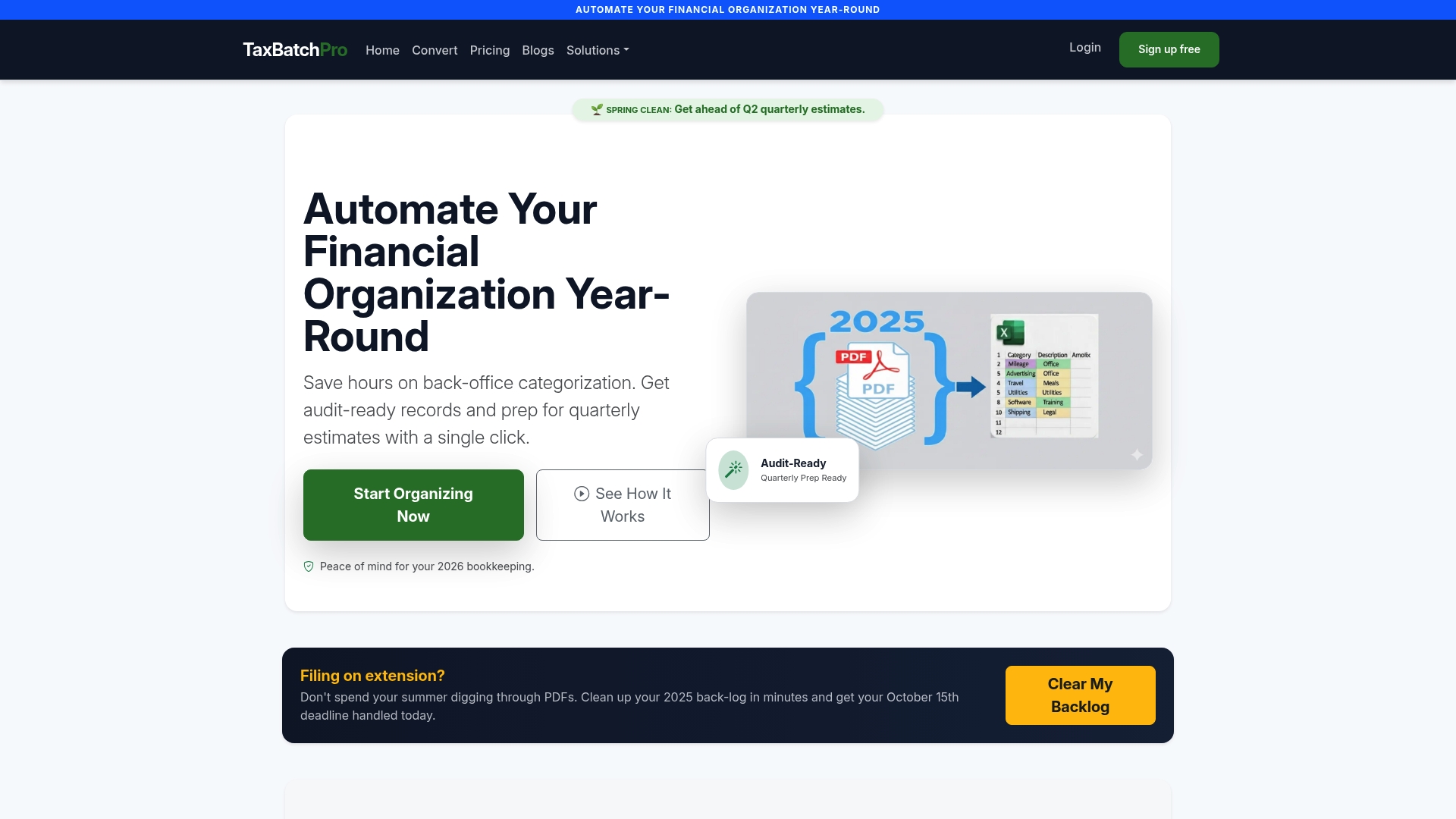
That matters directly for everything covered above: consistent categorization is what auditors want to see, and manual entry is where misclassification and commingling errors creep in unnoticed. Taxbatchpro processes a year's worth of statements in under 90 seconds and exports the result in a format built for tax prep, whether you're a sole proprietor handling your own Schedule C or an accountant managing statements for a dozen clients. This is a bookkeeping and organization tool, not tax or legal advice; for complex allocation questions or entity-specific rules, talk to a CPA or tax attorney. If you're rebuilding records for expense tracking across a growing business, start by converting last year's statements at the IRS-ready statement conversion page and see how much of your reconciliation work disappears in the first pass.
Frequently Asked Questions
What counts as a business expense for tax purposes? A business expense is any cost that is ordinary and necessary for operating your trade or business under IRC §162. Rent, wages, supplies, and business travel typically qualify; personal, living, or family expenses do not, even if paid from a business account.
Why does mixing personal and business expenses hurt your deductions? Commingling makes it difficult to prove which transactions were legitimately business-related, which increases audit risk and can lead an examiner to disallow deductions or expand the scope of the review. It also complicates mixed-use allocation, since you lose the clean paper trail needed to justify a business-use percentage.
What are some examples of mixed personal and business expenses? A cell phone plan used for both client calls and personal texting, a vehicle driven for both deliveries and errands, and a home internet subscription used for work and streaming are all classic examples. Each requires you to calculate and document a business-use percentage rather than deducting the full cost.
Are business meals fully deductible? No. Business meals are generally limited to a 50% deduction, even when clearly tied to client work, under the rules detailed in IRS Publication 463.
Can you deduct a business gift? Yes, but only up to $25 per recipient per year. Anything above that limit isn't deductible, and entertainment-related costs like tickets or rounds of golf are nondeductible entirely after the Tax Cuts and Jobs Act.
How long should you keep business expense records? Confirm the specific period for your situation using IRS guidance.
This article is general information, not a substitute for advice from a qualified financial advisor. Consult a qualified financial professional about your own circumstances before acting on anything here.
Sources
- 26 U.S.C. §162 - Trade or business expenses
- Income & expenses | Internal Revenue Service
- About Publication 535 (Business Expenses) | Internal Revenue Service
- Guide to business expense resources
Recommended
- How to Organize Business Expenses for Tax Time - TaxBatchPro Blog - TaxBatchPro
- Expense Tracking Software Explained for Small Businesses - TaxBatchPro Blog - TaxBatchPro
- Expense Report Preparation: A Guide for Small Businesses - TaxBatchPro Blog - TaxBatchPro
- Tax & Bookkeeping Insights - TaxBatchPro