Business Entity Tax Obligations: What Each Structure Requires

Your entity decides who files what form and who pays what tax. Pass-through owners, meaning sole proprietors, partners, and S corporation shareholders, report business income on their personal returns. C corporations get taxed at the entity level, currently a flat 21% federal rate. That single distinction drives almost everything else: which IRS forms land on your desk, whether Schedule SE applies to you, and how much you owe before April even arrives.
Three things need to happen now, regardless of which entity you picked. Get an EIN if you don't have one. Set up payroll before you hire anyone, not after. Start a dedicated tax reserve account for quarterly estimated payments, because the federal system runs on a pay-as-you-go basis, not as an annual surprise.
- Confirm your entity's default tax classification with the IRS before assuming how you'll be taxed
- Open a separate savings account earmarked only for estimated tax transfers
- Pull IRS Publication 583 if you're still deciding on structure
Quick fact: Self-employment tax runs 15.3% of net earnings, covering Social Security and Medicare, and it hits sole proprietors and many LLC members regardless of how small the business is.
Key Takeaways
Entity type determines who files which tax form, whether income faces self-employment tax or corporate tax, and how much administrative overhead your bookkeeping needs to absorb.
| Point | Details |
|---|---|
| Match entity to filing form | Sole proprietors use Schedule C, partnerships file Form 1065, S corps file Form 1120-S, and C corps file Form 1120. |
| Budget for self-employment tax | Sole proprietors and active partners owe 15.3% self-employment tax on net earnings, reported on Schedule SE. |
| Pay quarterly, not annually | Estimated payments are due April 15, June 15, September 15, and January 15 regardless of your entity. |
| Watch state-level traps | Franchise taxes, minimum LLC fees, and PTET elections add costs that federal rules never mention. |
| Automate statement reconciliation | Taxbatchpro converts scanned bank and credit card statements into Schedule C mapped spreadsheets in under 90 seconds. |
Table of Contents
- Types of Business Entity Tax Obligations, Entity by Entity
- Self-Employment Tax, Payroll, and Other Cross-Cutting Filings
- Choosing or Changing Your Entity for Tax Reasons
- State and Local Tax Obligations That Catch Owners Off Guard
- A Monthly and Year-End Recordkeeping Checklist
- Key Tax Deadlines and Filing Timelines by Entity
- What Happens When You File Late or Get It Wrong
- Tax Credits and Deductions Tied to Entity Type
- Sources
Types of Business Entity Tax Obligations, Entity by Entity
Each structure carries its own combination of forms, tax exposure, and administrative overhead. Here's how the five most common entity types break down.
1. Sole proprietorship. You report business income on Schedule C, attached to your personal Form 1040, and calculate self-employment tax on Schedule SE. There's no legal separation between you and the business for federal tax purposes, which means every dollar of net profit is exposed to both income tax and the 15.3% self-employment tax. Estimated quarterly payments are mandatory once you expect to owe tax for the year.
2. General partnership. Partnerships file Form 1065, an information return, then issue each partner a Schedule K-1 showing their share of income, deductions, and credits. The partnership itself pays no federal income tax. Each partner reports their K-1 allocation on their personal return and typically owes self-employment tax on active partnership income, including guaranteed payments for services rendered.
3. LLC (default classification). An LLC is a state law entity, not a federal tax classification, so the IRS applies default rules based on membership. A single-member LLC is disregarded for income tax and folds into the owner's Form 1040, though it still needs its own EIN for payroll and certain excise tax filings. A multi-member LLC defaults to partnership taxation and files Form 1065. Either version can elect corporate treatment using Form 8832 or S corporation status using Form 2553.
4. S corporation. An S corp files Form 1120-S and distributes Schedule K-1s to shareholders, who report their share of income on personal returns. The catch that trips up new owners: if you work in the business, the IRS requires you to pay yourself a reasonable salary through payroll, subject to employment tax withholding. Distributions beyond that salary avoid self-employment tax, which is the entire reason many owners elect S status once profits climb.
5. C corporation. A C corp files Form 1120 and pays tax at the flat 21% federal corporate rate. Profits distributed as dividends get taxed again on the shareholder's personal return, the double taxation problem every business owner eventually hears about. C corp status can still make sense if you're retaining earnings for growth, planning to raise venture capital, or aiming for Qualified Small Business Stock (QSBS) treatment down the road.
Pitfalls worth flagging:
- Sole proprietors often forget that business and personal expenses must stay separated on the books, not just on paper
- Partners frequently miss that guaranteed payments still trigger self-employment tax
- LLC owners assume the LLC label itself changes tax treatment, when it's the classification election that matters
- S corp owners underpay themselves through payroll to dodge payroll tax, a move the IRS actively audits for
- C corp owners forget the 21% rate applies before any dividend is even distributed
Pro Tip: Before filing your first S election, run a projection of reasonable salary versus distributions. Setting salary too low is one of the fastest ways to draw IRS scrutiny.
Self-Employment Tax, Payroll, and Other Cross-Cutting Filings
A handful of tax categories apply no matter which entity you chose, and understanding them keeps you from mapping the wrong form to the wrong obligation.
Self-employment tax covers Social Security and Medicare for anyone not on a payroll, calculated on Schedule SE at 15.3% of net earnings up to the wage base, plus 2.9% Medicare on earnings above it. Employment taxes kick in once you have employees: you withhold federal income tax, match Social Security and Medicare contributions, and pay federal unemployment tax (FUTA) using Form 940, reporting quarterly wages on Form 941 or annually on Form 944.
Estimated tax payments apply broadly. Individuals, including sole proprietors and partners, use Form 1040-ES; corporations use Form 1120-W. Missing these isn't a minor slip, since the IRS charges penalties calculated on the shortfall and how late the payment arrived.
Excise taxes apply narrowly but matter when they hit: fuel, certain trucks over 55,000 pounds (Form 2290), and various other goods or services reported on Form 720.
- Get an EIN before your first hire, even if you're a single-member LLC
- File Form 941 quarterly if you run payroll; smaller employers may qualify for annual Form 944
- Budget estimated payments around the four general tax categories: income, self-employment, employment, and excise
Choosing or Changing Your Entity for Tax Reasons
Entity decisions should follow the numbers, not the other way around. Weigh four factors: your income level, how much you plan to distribute versus retain, whether outside investors are in the picture, and whether QSBS treatment matters for an eventual sale.
- Elect S status using Form 2553, filed within two months and fifteen days of the tax year you want it to apply.
- Elect corporate classification for an LLC using Form 8832 if C corp treatment fits better than the default.
- Watch for transition traps: deemed distributions when converting, basis adjustments that affect future gain calculations, and payroll setup that needs to be live before the election takes effect, not after.
- Build a conversion checklist: consult an advisor, confirm timing against IRS deadlines, adjust withholding and payroll systems, and file amended returns if the election changes mid-year.
Pro Tip: Never flip your entity election in the same quarter you're setting up payroll for the first time. Stagger the two so a filing mistake in one doesn't cascade into the other.
State and Local Tax Obligations That Catch Owners Off Guard
Federal rules get most of the attention, but state and local obligations often add real cost that owners don't budget for.
- Minimum LLC fees and franchise taxes apply in many states regardless of whether the business turned a profit
- Pass-Through Entity Tax (PTET) elections let some pass-through owners deduct state taxes at the entity level, working around the federal cap on state and local tax deductions
- Missing an annual report or registration filing can cost you good standing, which then complicates licensing renewals or loan applications
- City-level corporate taxes exist in several jurisdictions on top of state tax, independent of your federal entity classification
Check your state's department of revenue and secretary of state pages before assuming your federal structure tells the whole story. Budgeting for these fees as a fixed cost, not a variable one, avoids the cash-flow surprise that catches new owners every year.
A Monthly and Year-End Recordkeeping Checklist
Staying compliant is less about knowing the rules and more about running the same routine every month without skipping it.
- Monthly: Reconcile every bank and credit card statement, categorize receipts against Schedule C categories, and confirm payroll tax deposits went through.
- Quarterly: Calculate and remit estimated taxes, top off your tax reserve, and reconcile retirement plan contributions if you offer one.
- Year-end: Finalize payroll forms, issue 1099s to contractors, and prepare Schedule C, K-1s, or Form 1120 depending on your entity.
- Audit readiness: Retain receipts, bank statements, and payroll records for at least three years, longer if you underreported income by more than 25%.
Pro Tip: Reconciliation is where most small errors hide until tax season exposes them all at once. Catch them monthly instead of in April.
The gap between a clean set of books and a chaotic one usually isn't effort, it's tooling. Automated statement extraction that maps transactions straight to Schedule C categories turns a weekend of manual reconciliation into a task you finish before your coffee gets cold.
Key Tax Deadlines and Filing Timelines by Entity
Deadlines shift depending on your entity, and missing the wrong one can cascade into penalties on returns you haven't even filed yet.
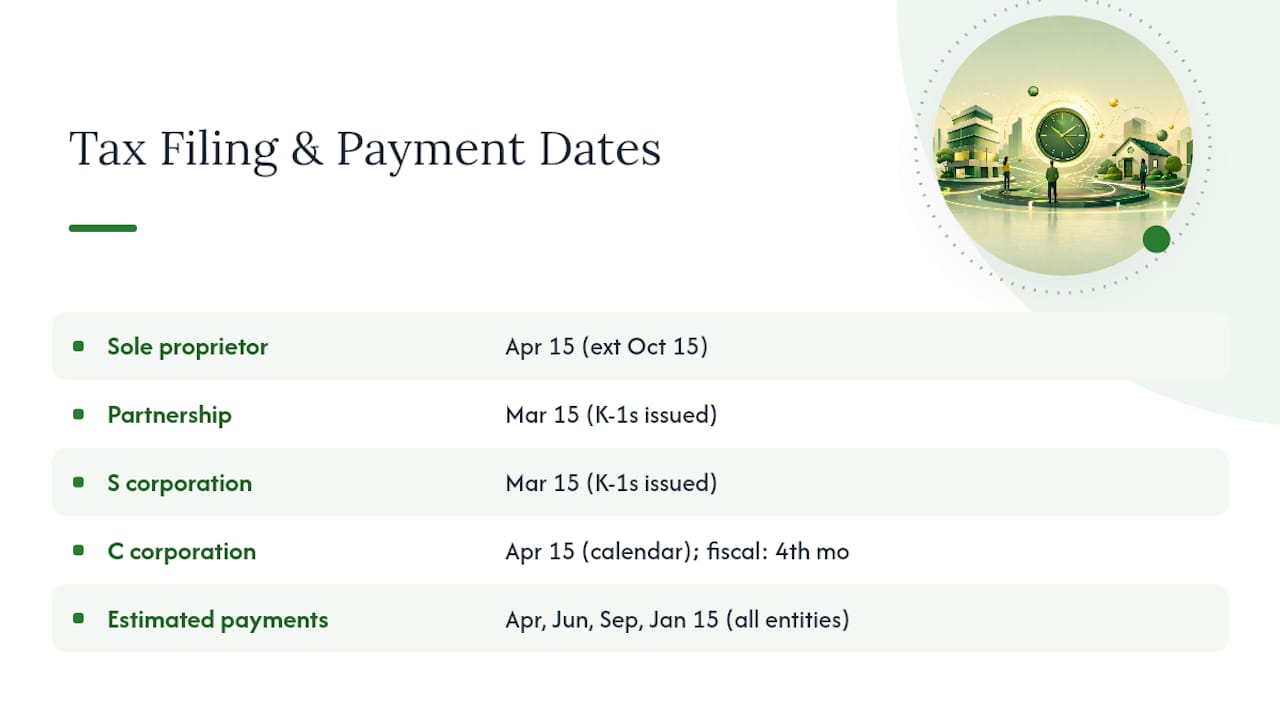
Sole proprietors file Schedule C with their personal Form 1040 by April 15, with an automatic extension to October 15 if requested. Partnerships file Form 1065 by March 15, a full month ahead of the personal deadline, since partners need their K-1s in hand before completing their own returns. S corporations follow the same March 15 deadline for Form 1120-S, for the same reason. C corporations file Form 1120 by April 15 for calendar-year filers, though fiscal-year corporations follow the 15th day of the fourth month after their year closes.
Estimated quarterly payments run on a separate calendar entirely: April 15, June 15, September 15, and January 15 of the following year, regardless of entity type. Extensions push back your paperwork deadline, never your payment deadline. That distinction confuses more owners than any other rule in the tax code, and it's the one that generates the most avoidable interest charges.
Build your internal calendar around the earlier of the two dates for any pass-through entity. If you're a partner or S corp shareholder, your K-1 arriving late because the entity missed March 15 doesn't excuse your own late personal filing.
What Happens When You File Late or Get It Wrong
The IRS calculates penalties on two tracks: failure to file and failure to pay, and they stack. Interest compounds daily on top of both, so a small mistake left alone for months turns expensive fast.

Partnerships and S corporations face a distinct penalty structure since they file information returns rather than pay tax directly. Each carries a per-partner or per-shareholder penalty for late Schedule K-1 delivery, multiplied by every owner on the return. A three-partner firm that misses the March 15 deadline pays that penalty three times over, not once.
Underpayment of estimated tax carries its own penalty, calculated based on how much you owed and how late the shortfall was corrected. You can generally avoid it by paying at least 90% of the current year's liability or 100% of last year's, whichever is smaller, through your quarterly installments.
Reasonable cause relief exists for first-time penalties or genuine hardship, but it requires a written explanation and doesn't apply automatically. If you catch an error yourself, filing an amended return promptly, Form 1040-X for individuals or the corresponding amended form for your entity, generally reduces the penalty exposure compared to waiting for the IRS to find it first.
Tax Credits and Deductions Tied to Entity Type
The Qualified Business Income (QBI) deduction is the single biggest entity-specific break available right now. C corporations don't qualify, since QBI is built specifically for pass-through taxation.
Beyond QBI, most deductions are shared across entity types but land differently depending on structure. Section 179 expensing and bonus depreciation apply the same way whether you're a sole proprietor or a corporation, but how the deduction flows through, straight to your personal return versus through a K-1, depends entirely on entity choice.
C corporations get access to a wider set of fringe benefit deductions, including fully deductible health insurance premiums for owner-employees, something S corp shareholders face restrictions on. Research and development credits, the work opportunity tax credit, and the small business health care tax credit apply across entity types but require different reporting mechanics depending on whether you're filing Schedule C, Form 1065, Form 1120-S, or Form 1120.
Match your deduction strategy to your entity before assuming a break you read about actually applies to your structure.
A Practitioner's Take on What Actually Trips Owners Up
The mistake I see most often isn't picking the wrong entity. It's underestimating what that entity demands operationally: missed estimated payments in year one of self-employment, or payroll setup delayed until after the S election already took effect. A monthly bookkeeping checkpoint, even fifteen minutes, paired with a dedicated tax reserve account, catches both problems before they compound into penalties.
How Taxbatchpro Cuts the Time You Spend on Statement Prep
Taxbatchpro turns the part of tax prep everyone dreads, manually transcribing months of bank and credit card statements, into something that takes under 90 seconds per year of records. Upload scanned PDFs in batches, and the platform extracts every transaction into a structured spreadsheet with automatic Schedule C category mapping already applied.
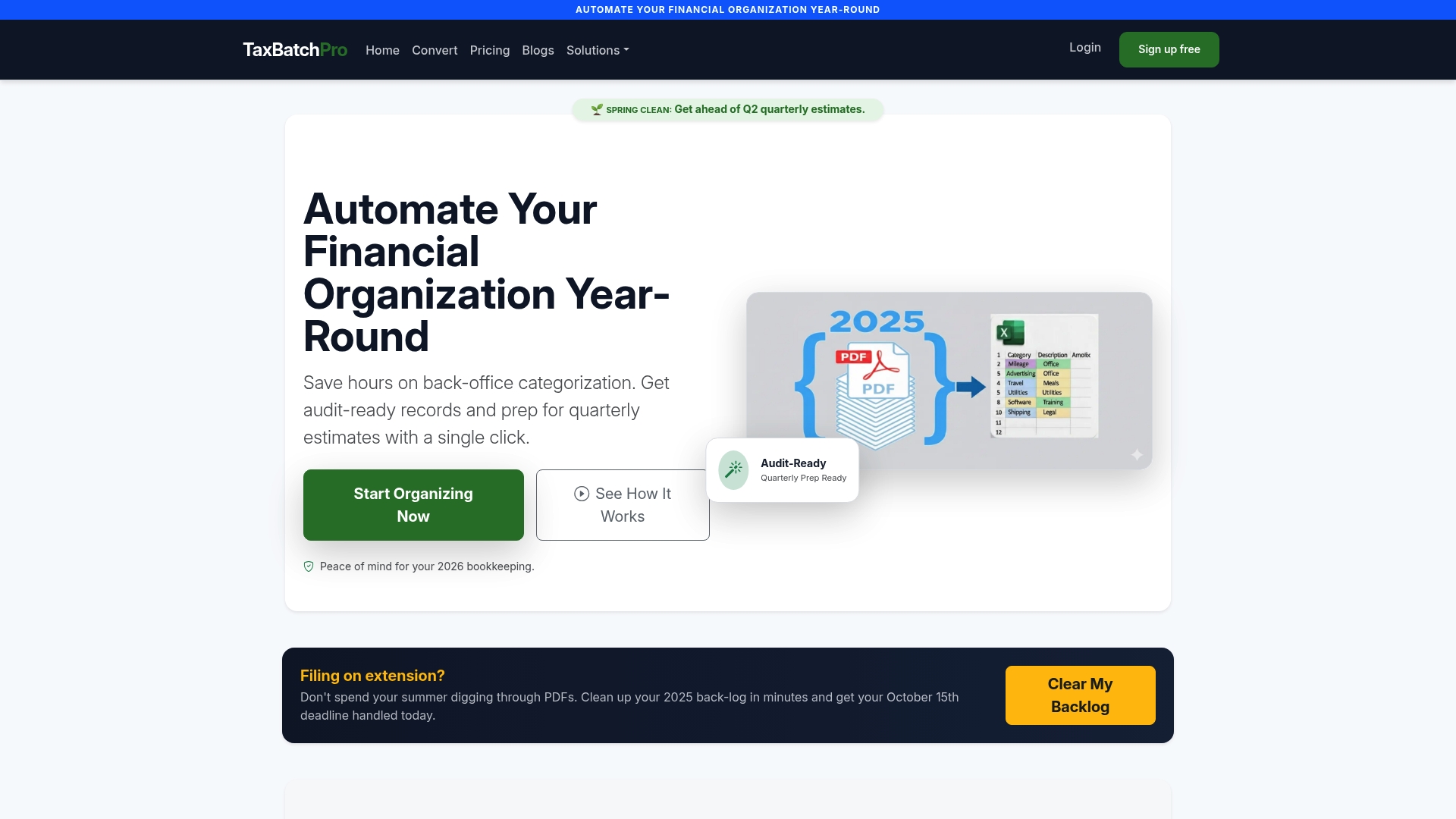
For sole proprietors and partners tracking self-employment tax exposure, or accountants managing K-1 workpapers across multiple clients, that speed compounds fast: fewer manual entry errors, cleaner audit trails, and reconciliations that used to eat a weekend now finished before lunch. If you're managing statement conversion for clients rather than just your own books, the dedicated workflow for accounting professionals handles volume differently than the individual tool.
Start with a batch of last quarter's statements and see how the core conversion tool maps your transactions before your next filing deadline arrives.
Sources
- IRS Publication 583: Starting a Business and Keeping Records
- CRS: Federal Tax Treatment of Business Entities (R43104)
- Taxpayer Advocate: Small-business tax highlights (2026)