Tax Basis for Business Assets: What Owners Need to Know

Tax basis measures your investment in a business asset and, together with the sale price, determines the taxable gain or loss when you sell it. The mechanics are simple in concept: taxable gain equals sale price minus adjusted basis, though certain items along the way can push that adjusted number up or down. Get the basis wrong and you either overpay tax on a sale or invite an IRS adjustment when the numbers don't reconcile.
Before you calculate anything, take these steps:
- Pull every purchase invoice, bill of sale, and closing statement for the asset in question.
- Locate records of capital improvements made after acquisition.
- Gather your depreciation schedules, including Form 4562 filings from prior years.
Key Takeaways
Adjusted basis, not the original purchase price, is what determines taxable gain or loss when a business asset is sold or disposed of.
| Point | Details |
|---|---|
| Basis drives gain calculation | Taxable gain equals sale price minus adjusted basis, not sale price minus purchase price. |
| Capitalize acquisition costs | Freight, installation, sales tax, and setup fees belong in initial basis, not as expenses. |
| Depreciation reduces basis regardless | Allowable depreciation lowers basis even if you never claimed it on a return. |
| Special cases need different rules | Gifts carry over basis; inherited assets get stepped-up basis at date of death. |
| Documentation determines audit outcomes | Keep invoices, improvement records, and depreciation schedules organized by asset. |
Table of Contents
- What Is Tax Basis for Business Assets, and How Does It Differ from Cost Basis?
- What Costs Count Toward Initial Basis?
- How Does Adjusted Basis Change over Time?
- How Do You Calculate Tax Basis Step by Step?
- What Happens with Gifts, Inheritances, and Business Conversions?
- How Should You Keep Records to Support Tax Basis?
- How Does Tax Basis Affect the Sale of a Business?
- What Business Owners Consistently Get Wrong About Basis
- Sources
What Is Tax Basis for Business Assets, and How Does It Differ from Cost Basis?
Cost basis and tax basis get used interchangeably, but they describe different points in time. Cost basis is what you paid initially: purchase price plus the capitalizable costs of acquiring the asset. Adjusted basis, often called tax basis at the point of sale, is that starting figure after every increase and decrease the tax code requires along the way.
Book or accounting basis is a separate animal entirely. Financial statements often use different depreciation methods or useful lives than the IRS allows, so an asset's book value on your balance sheet rarely matches its tax basis. Publication 551 lays out the federal rules for computing basis, while Wex at Cornell's Legal Information Institute offers a clean legal definition: the value used to calculate taxable gain, typically purchase price plus related acquisition costs like taxes, fees, and transportation.
Three distinctions worth locking in:
- Cost basis is a snapshot at purchase; adjusted basis moves over the asset's life.
- Book basis follows GAAP; tax basis follows the Internal Revenue Code.
- Only tax basis determines your gain or loss on the return you file.
What Costs Count Toward Initial Basis?
Initial basis is rarely just the sticker price. IRC §1012 sets cost as the default measure of basis, and the IRS expects you to capitalize every cost tied to getting the asset ready for use, not just the invoice total.
Capitalize these into initial basis whenever they apply:
- Purchase price negotiated with the seller.
- Sales tax paid on the transaction.
- Freight and delivery charges to get the asset to your location.
- Installation and setup labor, including testing before the asset goes into service.
- Legal, broker, or appraisal fees directly tied to the acquisition.
If you produce or construct the asset yourself, the uniform capitalization rules under Section 263A generally require you to capitalize direct and indirect production costs too, not just materials.
Pro Tip: Freight and installation invoices often arrive separately from the main purchase invoice and get coded as ordinary expenses by mistake. Cross-check every invoice tied to a new asset's purchase date, not just the one with the biggest dollar amount.
How Does Adjusted Basis Change over Time?
Basis is not a fixed number. It moves every year an asset is in service, and both directions matter for your eventual tax bill.
Increases to basis come from capital improvements: a new roof on a rental building, an engine rebuild on business equipment, an addition that extends useful life or adds capacity. Routine repairs that just maintain the asset don't count. Legal fees to defend title and certain assessments for local improvements also add to basis.
Decreases to basis come primarily from depreciation and amortization deductions claimed on Form 4562, plus casualty or theft losses that reduced the asset's value and Section 179 expensing taken in the year of purchase.
Here's the detail that trips up sellers most often: Publication 551 makes clear that allowable depreciation reduces basis whether or not you actually claimed it on your return. If you were entitled to deduct depreciation and didn't, the IRS still treats your basis as if you had. Skip depreciation for three years hoping to preserve a higher basis at sale, and you'll find the reduction applied anyway, just without the tax benefit you left on the table.
Recapture rules compound this. Depreciation and Section 179 deductions you claimed get taxed as ordinary income up to the amount of gain attributable to those deductions when you sell, under depreciation recapture provisions tied to the asset's basis history. That's why a full depreciation schedule, not just a current basis number, matters at disposition:
- Track claimed depreciation by year and method.
- Note any allowable-but-unclaimed depreciation separately.
- Flag Section 179 or bonus depreciation elections, since they accelerate both the deduction and the eventual recapture exposure.
How Do You Calculate Tax Basis Step by Step?
The formula rarely changes: adjusted basis = initial basis + increases − decreases. Two examples show how it plays out in practice.
Example 1: Equipment purchase. You buy a machine with a purchase price and incur additional freight and installation costs, which together establish the initial basis. Over several years you claim depreciation deductions that reduce the adjusted basis. When you sell the machine, the taxable gain equals the sale price minus the adjusted basis.
Example 2: Business purchase allocation. When you buy an entire business, the price gets allocated among individual assets using the residual method, working from cash and securities down through tangible assets to goodwill. Both buyer and seller report this allocation on Form 8594, and both sides must use consistent figures or risk an IRS mismatch.
What Happens with Gifts, Inheritances, and Business Conversions?
Purchase price isn't always the starting point. Four scenarios require different basis rules entirely.
- Gifts carry over the donor's basis to the recipient, though basis for computing a loss is limited to fair market value at the time of the gift if that value is lower.
- Inherited property typically gets a stepped-up (or occasionally stepped-down) basis equal to fair market value at the date of death, wiping out decades of unrealized gain for the heir.
- Personal-to-business conversions, like turning a car or home office into business-use property, set basis at the lower of your original cost or fair market value on the conversion date.
- Business acquisitions require allocating the total price among asset categories per the residual method, reported on Form 8594 by both parties.
Each scenario changes not just the starting number but the depreciation schedule and eventual gain calculation that follow it.
How Should You Keep Records to Support Tax Basis?
Basis calculations only hold up if the paperwork behind them does. Auditors don't take your word for a $55,000 initial basis figure; they want the invoices.
Keep these on file, ideally digitized and organized by asset:
- Original purchase invoices and bills of sale.
- Closing statements for real estate or business acquisitions.
- Invoices for capital improvements, separated from repair receipts.
- Complete depreciation schedules tied to Form 4562 filings.
- Form 8594 allocation schedules for any business purchase or sale.
Retain these records for as long as the asset is in service plus the statute of limitations period after disposition, generally three years from filing, though six years applies if you underreported gross income substantially. Organize files by asset, not by tax year, so a single folder tells the complete basis story from purchase to sale. The audit-ready records workflow approach works well here: one asset, one file, every supporting document attached chronologically.
Pro Tip: Small charges like $180 in installation labor or a $95 delivery fee rarely show up on the main equipment invoice. They hide in bank and credit card statements instead, which is exactly where they get missed at tax time.
This is where manual bookkeeping breaks down. A year's worth of bank and credit card statements can bury dozens of small, capitalizable charges across hundreds of transactions, and a bookkeeper skimming PDFs by eye tends to miss the ones that don't look like asset purchases. Automated statement extraction that maps transactions to Schedule C categories catches freight and installation charges wherever they land, tagging them to the right asset instead of letting them slip into a generic expense line. For finance teams juggling multiple fixed assets, a structured fixed-asset tagging workflow paired with automated extraction closes most of the gaps that show up at audit time.
How Does Tax Basis Affect the Sale of a Business?
Selling a business isn't one transaction for tax purposes; it's a bundle of separate asset sales, each with its own basis and gain calculation. The IRS requires allocation among assets using the residual method, and Form 8594 locks both buyer and seller into consistent figures.
Misallocated basis creates real friction. If the seller claims a higher allocation to goodwill (capital gain treatment) while the buyer wants more allocated to depreciable equipment (faster deductions), the mismatch invites IRS scrutiny on both returns.
Before closing, prepare:
- A complete asset-by-asset basis schedule with acquisition dates and depreciation history.
- Fair market value support for each asset category in the allocation.
- A draft Form 8594 that both parties agree on before signing.
What Business Owners Consistently Get Wrong About Basis
Most basis mistakes aren't conceptual. Business owners generally understand that a $50,000 machine has a $50,000 basis. The failures happen in the details: the $2,000 freight bill filed as a shipping expense, the $3,000 installation invoice buried in a contractor's statement, the depreciation schedule that stops getting updated after year two because nobody assigned ownership of the spreadsheet.
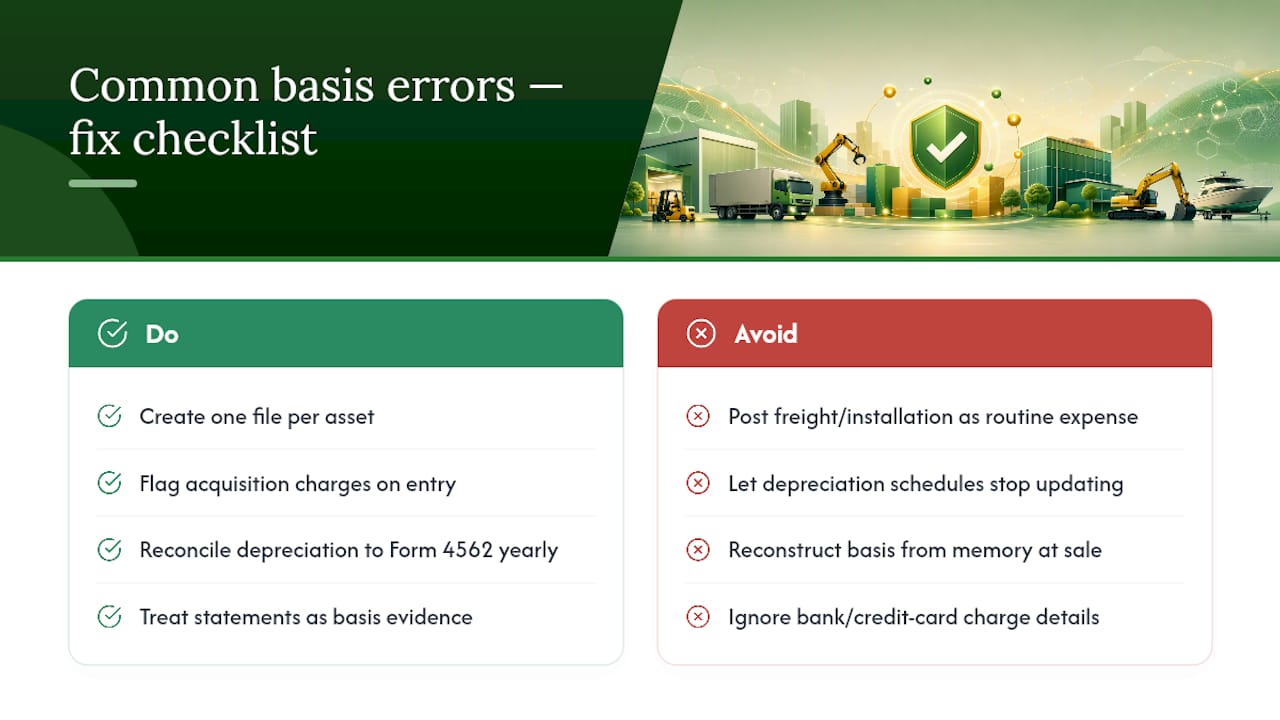
Conventional advice tells you to "keep good records," which is true and useless in equal measure. The real fix is procedural: every asset gets one file, every acquisition-related charge gets flagged at the point of entry, and depreciation schedules get reconciled annually against Form 4562, not reconstructed from memory during a sale.
The gift, inheritance, and conversion rules matter, but they affect a minority of transactions. The bigger cost, industry-wide, sits in ordinary equipment and property purchases where capitalizable charges hide inside routine bank and credit card statements. Fixing that requires treating statement data as basis evidence, not just cash flow history. That's a workflow problem before it's a tax problem, and it's worth solving before the sale, not during the audit.
This article is general information, not a substitute for advice from a qualified financial advisor. Consult a qualified financial professional about your own circumstances before acting on anything here.
Sources
- Publication 551 (Basis of Assets) | Internal Revenue Service
- tax basis | Wex | US Law | LII / Legal Information Institute