Schedule C Categories: The 2026 Filing Map for the Self-Employed

Schedule C organizes your deductible business expenses into named lines on Part II (Lines 8 through 27), plus separate sections for cost of goods sold, vehicle information, and home office use. If you have net self-employment earnings reaching the IRS filing threshold, you must file it. Start now by separating business transactions from personal ones, saving receipts, and logging mileage as it happens.
TL;DR:
- Most small business owners forget to include or properly categorize mileage, travel records, and small supplies, risking missed deductions.
- Accurate documentation like receipts, mileage logs, and bank statements must be kept for three years to substantiate all Schedule C deductions.
- Large equipment purchases may need depreciation using Form 4562 instead of immediate expensing with Section 179, especially for higher-cost assets.
- Only physical product-related costs belong in Part III; service businesses should avoid mixing operating expenses with cost of goods sold.
- Automating transaction categorization and monthly reconciliation significantly reduces time and errors when preparing Schedule C.
Table of Contents
- What Are the Schedule C Expense Categories?
- How Do You Categorize Common Business Expenses?
- What Records Does the IRS Require for Schedule C?
- When Do You Depreciate Equipment Instead of Expensing It?
- When Should You Fill Out Part III for Cost of Goods Sold?
- What Deductions Do Self-Employed Filers Miss Most Often?
- How Do You Prepare Your Books for Schedule C Filing?
- What Habits Actually Save You Time at Tax Season?
- Convert Your Statements Into Schedule C–Ready Data
- Where Can You Verify These Schedule C Rules?
- Sources
What Are the Schedule C Expense Categories?
Schedule C isn't a blank canvas. The IRS built it as five distinct parts, and Part II alone contains 20 named expense lines you'll need to match against your own bookkeeping categories. Get this mapping wrong, and you either miss deductions you're entitled to or invite a mismatch that draws IRS attention.
Here's the line-by-line structure, in the order the form actually uses:
- Line 8, Advertising: business cards, sponsored posts, signage, website hosting fees
- Line 9, Car and truck expenses: mileage or actual vehicle costs (Part IV asks for the supporting detail)
- Line 10, Commissions and fees: referral payments, affiliate payouts, broker commissions
- Line 11, Contract labor: payments to freelancers or subcontractors, usually reported on Form 1099-NEC
- Line 13, Depreciation and Section 179 expense deduction: requires Form 4562 for most equipment purchases
- Line 15, Insurance (other than health): liability, property, business interruption policies
- Line 16, Interest: mortgage interest on business property (16a) and other business loans (16b)
- Line 17, Legal and professional services: attorney fees, bookkeeper and CPA fees, consulting
- Line 18, Office expense: software subscriptions, printer ink, small office tools
- Line 19, Pension and profit-sharing plans: contributions to a SEP-IRA or Solo 401(k) for yourself
- Line 20, Rent or lease: vehicles, machinery, and equipment (20a) or other business property (20b)
- Line 21, Repairs and maintenance: fixing equipment or business property, not capital improvements
- Line 22, Supplies: consumable materials that aren't part of a finished product for resale
- Line 23, Taxes and licenses: business licenses, permits, and the employer portion of payroll taxes
- Line 24a, Travel: airfare, hotels, rental cars for business trips
- Line 24b, Deductible meals: subject to the 50% limitation
- Line 25, Utilities: business phone lines, internet, separate business utility accounts
- Line 26, Wages: pay to W-2 employees, separate from contract labor
- Line 27a, Other expenses: anything that doesn't fit elsewhere, detailed on Part V
- Line 30, Home office: calculated via Form 8829 or the simplified method
Part III covers cost of goods sold for anyone selling physical products. Part IV asks for vehicle details, including total miles driven and whether you have written evidence. Part V catches the leftovers.
That "other expenses" line deserves a warning. It's tempting to dump anything unclear into Line 27a, but the IRS instructions require you to itemize each item on Part V rather than lump them together as "miscellaneous." A vague $3,000 "other" entry with no breakdown is exactly the kind of line that invites a closer look. Break it out, even if that means five small entries instead of one large mystery figure.
How Do You Categorize Common Business Expenses?
The categories look simple until you hit a real transaction that doesn't fit cleanly. Here's where most sole proprietors get tripped up, and how to sort it correctly.
Airfare and hotel costs for that same business trip go on Line 24a and are fully deductible. The University of Illinois Tax School notes that meals face this cap while travel and car costs are tracked separately and need their own substantiation. Mixing the two on your books creates a category error that either overstates your deduction or understates it.
Vehicle expenses. You choose between the standard mileage rate or actual expenses (gas, repairs, insurance, depreciation), and you can't switch freely between the two once you've picked a method for a given vehicle. Either way, Part IV wants your documentation:
- Date of each trip
- Business purpose
- Starting and ending odometer readings or total mileage
- A contemporaneous log, not a reconstruction built in April
Home office. The simplified method lets you deduct $5 per square foot of dedicated office space, up to 300 square feet. The regular method requires Form 8829 and a percentage-of-home calculation based on square footage, but it can capture more if your home costs are high. Either way, the space must pass the exclusive-use test: a guest bedroom that doubles as an office on weekends doesn't qualify.
Software and subscriptions. A $15 monthly project management tool goes straight to Line 18 as office expense. A $3,000 annual software license with a multi-year benefit may need to be capitalized and depreciated instead, following the same rules covered under Section 179.
Supplies versus cost of goods sold. If you sell physical products, the raw materials that become part of what you sell belong in Part III, not on the supplies line. Service providers, by contrast, keep pens, printer paper, and shipping boxes on Line 22.
Pro Tip: Annotate each meal or travel receipt with who you met and why, right when you get it. A six-month-old receipt with no context is far weaker evidence than a one-line note written the same day.

What Records Does the IRS Require for Schedule C?
The IRS puts the burden of proof on you. The Schedule C instructions state plainly that every deduction must be both "ordinary and necessary" for your line of work, and a receipt alone doesn't always establish that. A stack of gas station receipts means nothing if you can't tie them to business mileage.
Here's what qualifies as acceptable documentation and how long to keep it:
- Receipts and invoices for every expense claimed, ideally scanned or photographed the day you get them.
- Bank and credit card statements that corroborate the receipts and show the transaction actually cleared.
- Contracts and calendar entries that establish the business purpose behind meetings, travel, or contract labor payments.
- Mileage logs with dates, destinations, and business purpose, kept as you drive rather than reconstructed later.
- Retention: keep most records for three years after filing, but hold onto asset purchase records and employment tax documentation longer, since depreciation schedules and payroll issues can stay open past the standard window.
The most practical habit is running everything through one dedicated business bank account and reconciling it monthly. Mixed personal and business transactions on a single card create hours of untangling work every April, and they're the single most common reason sole proprietors lose deductions they actually earned. A clear picture of what counts as a legitimate business expense helps you make that call before the receipt ever hits a drawer.
When Do You Depreciate Equipment Instead of Expensing It?
Not every equipment purchase is an immediate deduction. Section 179 lets you expense the full cost of qualifying equipment in the year you buy it, up to annual limits set by the IRS, rather than spreading the deduction over several years. The IRS also allows a simplified de minimis expensing threshold for smaller tangible property purchases, which cuts down on recordkeeping for items like a $600 laptop.

Larger purchases outside those limits typically follow MACRS depreciation schedules, detailed in IRS Publication 946, or bonus depreciation rules. Either path usually requires Form 4562. On Schedule C itself, the deduction lands on Line 13, but keep a separate asset schedule listing each item, its purchase date, and the depreciation method you chose. That schedule is what an auditor will ask for first.
When Should You Fill Out Part III for Cost of Goods Sold?
Part III applies only if you sell a physical product. It captures beginning inventory, purchases made during the year, direct labor tied to production (not your own owner compensation), materials and supplies that become part of the product, and freight-in costs, then nets those against ending inventory to calculate cost of goods sold.
Service businesses generally shouldn't touch Part III at all. A freelance graphic designer has no inventory to count, so their laptop, software, and stock photo subscriptions belong on the regular expense lines, not in the COGS section. As TaxAct explains, COGS is limited to direct product costs, and misclassifying operating expenses as COGS artificially inflates your gross profit figure, which distorts every calculation that follows on the form.
What Deductions Do Self-Employed Filers Miss Most Often?
A handful of deductions slip through year after year, usually because they don't feel like "real" business expenses at the moment they're incurred:
- Bank and payment processing fees, including the percentage Stripe, Square, or PayPal takes from every invoice
- Small supply purchases under $20 that never get logged because they feel too minor to track
- Business insurance premiums, especially professional liability or errors-and-omissions coverage
- Professional development, such as industry courses, certifications, or conference registration
- De minimis equipment purchases that qualify for immediate expensing instead of depreciation
Tag every transaction the same month it happens, and attach a short purpose note to anything ambiguous. Waiting until March to sort a year of transactions is how legitimate deductions get missed or misfiled.
How Do You Prepare Your Books for Schedule C Filing?
Getting from a shoebox of statements to a filing-ready Schedule C comes down to six steps:
- Gather every business bank and credit card statement for the year.
- Separate business transactions from personal ones, line by line.
- Map each transaction to its correct Schedule C line, from advertising through other expenses.
- Record mileage with dates and business purpose, not an end-of-year estimate.
- Reconcile the totals against your bank statements and review for anything miscategorized.
- Export a Schedule C–ready report your preparer, or you, can drop straight into the form.
Step three is where most people lose hours, manually reading through statements and guessing at categories. Automating that mapping with batch PDF extraction and deterministic category rules cuts that work down dramatically, since the platform reads scanned statements and assigns each transaction to its matching Schedule C line automatically.
Pro Tip: Run your reconciliation monthly instead of annually. A 12 month backlog of unsorted transactions is where classification mistakes multiply.
What Habits Actually Save You Time at Tax Season?
The sole proprietors who breeze through tax season aren't smarter about tax law. They reconcile monthly, use the same category names every time, and jot down the business purpose on a receipt the moment they get it, not three months later when the memory's gone. A tool that exports transactions already mapped to Schedule C lines removes the guesswork that eats up April.
— Ian
Convert Your Statements Into Schedule C–Ready Data
Taxbatchpro turns a year of scanned bank and credit card statements into a categorized, tax-ready spreadsheet in minutes instead of the hours manual sorting usually takes.
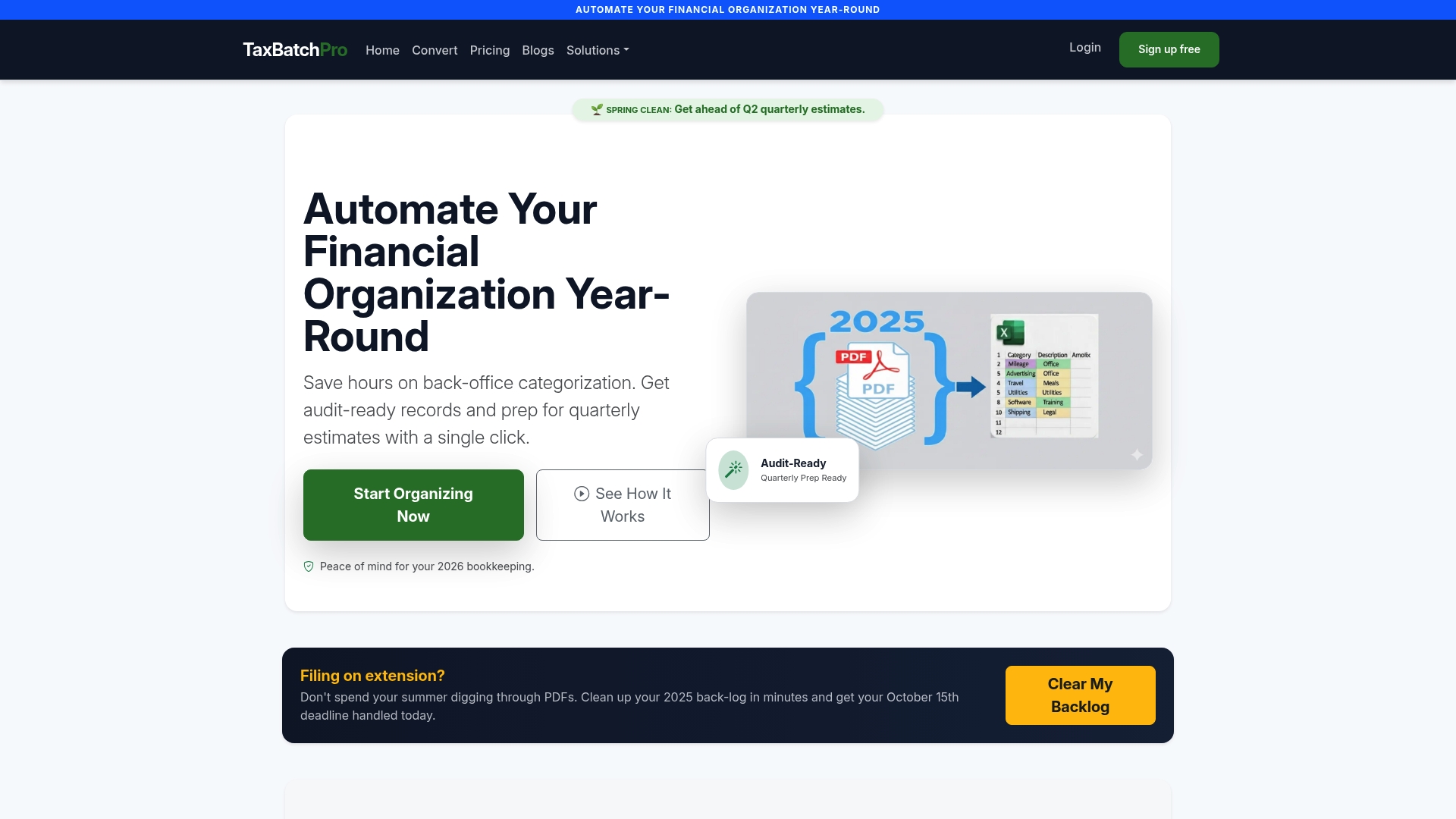
Rather than reading through twelve months of PDFs and guessing which line each purchase belongs on, the platform's batch upload reads your statements and maps each transaction to its Schedule C category automatically, producing an audit-ready export you or your preparer can use directly. Sole proprietors juggling a single year of records benefit the same way accountants handling a stack of client files do: less time reclassifying transactions, more time reviewing the numbers that matter. If you're preparing multiple client returns, the professional-tier tools built for accountants handle volume without repeating the setup each time.
Try the free bank statement converter on last month's statement and see how the categorization lines up with your own Schedule C before committing to a paid plan.
Where Can You Verify These Schedule C Rules?
- Schedule C (Form 1040) Instructions, IRS
- Schedule C (Form 1040) form PDF, IRS
- Publication 463: Travel, Gift, and Car Expenses, IRS
- Publication 946: How To Depreciate Property, IRS
This article is general information, not a substitute for advice from a qualified financial advisor. Consult a qualified financial professional about your own circumstances before acting on anything here.
Sources
- Schedule C (Form 1040) Instructions — IRS
- Schedule C (Form 1040) — IRS (Form PDF)
- Publication 463 (Travel, Entertainment, Gifts) — IRS
- Schedule C: How to report business income & expenses — TaxAct