Security & Procurement: 5 Critical Controls for Bank Statement OCR

Bank statement OCR can be secure enough for professional accounting and tax work, but only under a conditional standard: the vendor must run encryption in transit and at rest, enforce least-privilege access with MFA, maintain tamper-evident audit logs, document a tested incident response plan, and back all of it with a signed data processing agreement and ongoing vendor oversight. Skip any one of those five, and the "secure" label is marketing, not fact.
TL;DR:
- Ensuring vendor encryption in transit and at rest, along with MFA, tamper-proof logs, incident plans, and a signed data agreement, is essential to verify security.
- Controls like memory-only processing, field-level masking, scoped API keys, and write-once audit logs directly reduce data exposure risks during OCR workflow stages.
- Compliance with GLBA, SEC, and SOC 2 requires documented risk assessments, incident procedures, and effective control operation over extended periods, not just certifications.
- Operational discipline including data minimization, continuous vendor oversight, role-based access, and regular training are critical to maintaining a secure OCR pipeline.
- Monitoring volume spikes, suspicious access patterns, failed authentication attempts, and export activities should be ongoing and paired with clear response ownership.
Table of Contents
- What Is Bank Statement OCR Security, and Where Does the Pipeline Break?
- What Technical Controls Should You Require and Verify?
- What Do GLBA, SEC Rules, and SOC 2 Actually Require?
- How Should You Handle Retention, Vendor Oversight, and Access Lifecycle?
- How Do You Choose Between Cloud, Hybrid, On-Prem, and Air-Gapped Deployments?
- What Should You Ask a Vendor Before You Sign a Contract?
- How TaxBatchPro Applies These Controls in Practice
- Where Human Error Still Breaks a Secure OCR Pipeline
- How Should Extracted Statement Data Be Anonymized or Pseudonymized?
- What Monitoring and Alerting Should Run Continuously?
- Author Perspective: Recommended Priorities and Next Steps
- Get Audit-Ready Statement Conversion Without the Manual Risk
- Sources
What Is Bank Statement OCR Security, and Where Does the Pipeline Break?
Bank statement OCR extracts transaction data from scanned or photographed PDFs and converts it into structured rows a spreadsheet or accounting system can read. The pipeline runs through five stages: ingest, preprocess, OCR or intelligent document processing (IDP), validation, and export. Each stage creates a fresh copy of sensitive financial data, and each copy is a new place for that data to leak.
Ingest is where the raw PDF, often password-protected and containing full account numbers, routing numbers, and transaction histories, first lands on vendor infrastructure. Preprocessing deskews, denoises, and sometimes unlocks the file, which is the exact moment a poorly built system might write an unencrypted copy to disk. The OCR or IDP engine then reads the text and table structure, a step increasingly handled by machine learning models that can, if misconfigured, retain snippets of customer data in training logs or cache. Validation cross-checks extracted totals against expected formats, often routing data through a second service or human review queue. Export packages the final structured file, at which point a copy leaves the vendor's environment and enters the customer's systems.
Realistic threats cluster around a few patterns:
- Insider misuse: an employee with broad database access viewing or exporting customer statements without a business reason.
- Vendor compromise: a breach at the OCR provider itself, exposing every customer's documents in one incident.
- API exfiltration: an overly permissive or poorly scoped API key used to pull bulk data outside normal usage patterns.
- Model leakage: extracted transaction data inadvertently retained in logs, caches, or training datasets tied to the OCR model, a risk that grows as vendors layer generative AI onto traditional OCR without discovery and classification controls that travel with the data itself.
Mapping controls to these exact points, rather than trusting a generic security page, is the difference between a defensible vendor choice and an unpleasant audit finding.
What Technical Controls Should You Require and Verify?
Marketing pages love the phrase "bank-level encryption." Security reviewers need specifics, and specifics are checkable.
Encryption and key management. Data in transit should run on TLS 1.2 or 1.3, never an older protocol. Data at rest needs AES-256, with keys managed through a dedicated system, ideally a hardware security module (HSM) for high-sensitivity deployments, rather than embedded in application code. Ask who holds the keys and whether the vendor supports customer-managed keys.
Memory-only processing for protected documents. Password-protected bank statement PDFs should be unlocked in memory only, with the password and any unencrypted intermediate file purged immediately after extraction completes. This is one of the highest-value, lowest-cost controls available, and it directly prevents leftover cleartext artifacts from sitting on a vendor's disk long after the job finishes. Vendors that support this pattern typically pair it with ephemeral storage, meaning working files exist only for the duration of the job and are not retained by default, a claim OCR API providers frequently make and one you should ask to see demonstrated, not just described.
Field-level protection. Beyond whole-document encryption, mature pipelines apply tokenization or dynamic masking to specific fields, account numbers, and Social Security numbers embedded in memo lines, so that even someone with legitimate database access sees masked values unless they have a specific, logged reason to view the raw field. Column-level encryption for personally identifiable information (PII) and nonpublic personal information (NPPI) adds a second layer that survives even if broader database access controls fail.
API and network protections. Every integration point should use OAuth2 or JWT-based authentication with scoped API keys, not a single all-access credential. A web application firewall (WAF), rate limiting, and network segmentation between the OCR processing environment and other systems reduce the blast radius of any single compromised credential.
Tamper-evident logging. Audit logs need to be write-once, meaning nobody, including administrators, can quietly edit or delete an entry after the fact. Retention periods should align with the regulation governing the data, not an arbitrary default.
Here's the pattern reviewers keep missing: firewalls and network perimeters get most of the attention during vendor evaluation, while data-layer security, classification, encryption, masking, and logging applied directly to the data itself, is what actually determines whether a breach exposes usable customer information or an encrypted, useless blob. Perimeter defenses stop outsiders. Data-layer controls limit damage when the perimeter fails anyway, which it eventually will.
What Do GLBA, SEC Rules, and SOC 2 Actually Require?
Three frameworks govern most bank statement OCR deployments in accounting and tax contexts, and each translates into specific, checkable vendor and internal obligations.
The GLBA Safeguards Rule requires covered financial institutions and their service providers to maintain a written information security program built on a documented risk assessment, not a generic policy template. The rule specifically calls for a designated qualified individual accountable for the program, access controls, encryption or an equivalent compensating control, ongoing vendor oversight, and defined retention and secure disposal procedures, all subject to periodic reassessment rather than a one-time checklist.
The SEC's amended cybersecurity rules require covered entities to adopt written incident response procedures specifically for unauthorized access to customer information, and to notify affected individuals within a defined window rather than at the vendor's discretion. If your OCR vendor touches data covered by these rules, ask to see the written procedure, not a verbal assurance that "we have a process."
SOC 2 Type II functions as the independent evidence layer underneath both frameworks. Unlike a Type I report, which checks whether controls exist on a given day, Type II evaluates whether those controls operated effectively across an extended observation period, typically six to twelve months, across security, availability, processing integrity, confidentiality, and privacy. A vendor that can only produce a Type I report, or no report at all, is asking you to trust a snapshot instead of a track record.
A few overlapping standards matter depending on your data mix:
- PCI DSS applies if card numbers appear in the statements being processed, not just bank account data.
- State privacy laws (California, Virginia, and a growing list of others) impose their own notification timelines and data subject rights that can run parallel to GLBA and SEC obligations.
- Sector-specific rules may layer on top if the OCR output feeds into regulated reporting, such as filings tied to public company disclosures.
None of these frameworks certifies a specific OCR product. They certify a program, which is why the vendor's documentation matters as much as its feature list.
How Should You Handle Retention, Vendor Oversight, and Access Lifecycle?
Technical controls fail quietly without the operational discipline to back them up. Three areas deserve a written policy, not an informal understanding.
- Data minimization and retention. Set a defined retention window for extracted statement data and source PDFs, then enforce secure disposal at the end of it. Review the policy at least annually, since regulatory guidance and business need both shift.
- Vendor oversight. Every OCR vendor contract should include a data processing agreement (DPA) specifying permitted uses, subprocessor disclosure, and breach notification obligations. Continuous posture monitoring, not a one-time questionnaire at signing, catches drift as the vendor's environment changes.
- Identity lifecycle management. Enforce least privilege and MFA for every account touching the OCR pipeline, use privileged access management (PAM) for administrative accounts, and run access reviews on a fixed cadence, quarterly is common, with prompt deprovisioning when someone changes roles or leaves.
- Incident response readiness. Maintain a written playbook and run tabletop tests against it at least annually, with notification timelines that match whichever of the SEC or GLBA rules apply to your data.
Pro Tip: Run your incident response tabletop test with the vendor in the room, not just your own team. A plan that only exists on your side of the relationship breaks down fast when the actual incident originates in the vendor's environment.
How Do You Choose Between Cloud, Hybrid, On-Prem, and Air-Gapped Deployments?
The right architecture depends on residency requirements and how much cross-boundary data movement your compliance posture can tolerate.
Region pinning in public cloud keeps processing and storage within a defined geographic boundary, satisfying most residency requirements without the cost of dedicated infrastructure. It works for the majority of accounting and tax use cases.
Memory-only and ephemeral processing reduces persistent exposure regardless of where the infrastructure sits physically, since data that never touches permanent storage can't be recovered from a stolen disk or an abandoned backup.
On-prem or air-gapped deployments make sense for highly regulated clients where residency and isolation requirements rule out shared infrastructure entirely, typically large financial institutions or government-adjacent entities rather than a mid-size CPA firm.
Hybrid approaches keep some processing on the customer's infrastructure while calling out to a vendor API for specific steps. This requires securing every cross-boundary call with the same scoped authentication and encryption standards applied everywhere else in the pipeline, since a hybrid model only helps if the seam between environments is actually locked down.
What Should You Ask a Vendor Before You Sign a Contract?
A structured evidence request beats a sales call every time. Work through these steps in order:
- Request the SOC 2 Type II report under NDA and confirm the auditor's name and the report's coverage period; a report more than twelve months old deserves a follow-up question.
- Request the signed DPA template, along with the most recent penetration test summary and vulnerability scan results.
- Demand a live technical demo showing region pinning in action, memory-only processing for a password-protected sample file, and an exported audit log entry tied to that specific job.
- Request the incident response playbook and ask when it was last tested, plus evidence of employee background checks and security training cadence.
- Validate independently by contacting the auditor listed on the SOC 2 report, running a scoped test dataset through the vendor's system, and reviewing the completed vendor security questionnaire against what the demo actually showed.
Vendors confident in their controls will produce this evidence without friction. Hesitation on any single item is itself useful information. For a deeper look at how these controls interact with cost, review how OCR pricing structures shift once security and volume requirements enter the conversation.
How TaxBatchPro Applies These Controls in Practice
TaxBatchPro processes bank and credit card statements through a secure conversion pipeline built around the controls this article outlines: encrypted batch processing, configurable retention windows, and IRS Schedule C-ready exports designed for audit trails accountants can defend. Firms handling client statements at volume use it to standardize extraction without expanding who touches raw financial data. Detailed security and enterprise terms are available directly through the platform.
Where Human Error Still Breaks a Secure OCR Pipeline
Technical controls fail when the people operating around them don't understand why the controls exist. A staff member who screenshots a statement to share in a chat app has bypassed every encryption standard the vendor built, not through malice but through habit.
Effective training programs for OCR-adjacent workflows cover a narrow set of behaviors rather than generic security awareness. Staff need to know exactly what counts as a sensitive field within extracted statement data, why masked account numbers should stay masked in downstream reports, and what to do when an export looks wrong, which is often the first visible sign of a pipeline problem worth escalating rather than quietly fixing.
Training works best when it's role-specific. A bookkeeper uploading batches needs different guidance than an admin managing API keys or a partner reviewing exported files before they go to a client. Annual refreshers matter less than event-triggered training, meaning a short session tied to a new integration, a new hire, or a near-miss incident, since that's when the lesson actually sticks.
Track completion the same way you'd track any other control: with a record, a date, and a named owner. If your incident response playbook ever gets tested for real, an auditor or regulator will ask whether the people involved had been trained on the specific handling procedures relevant to the incident. "We have a training program" is a weaker answer than "here's the completion log from the quarter before the incident."
How Should Extracted Statement Data Be Anonymized or Pseudonymized?
Anonymization and pseudonymization solve different problems, and conflating them creates false confidence.
Pseudonymization replaces a direct identifier, an account number or name, with a token or reference code, while keeping a separate mapping table that allows re-identification when legitimately needed. This is the more common approach for OCR outputs feeding tax preparation, since accountants often need to trace a transaction back to a specific client account. Field-level tokenization, mentioned earlier as a technical control, is pseudonymization applied at the data layer rather than the document layer.
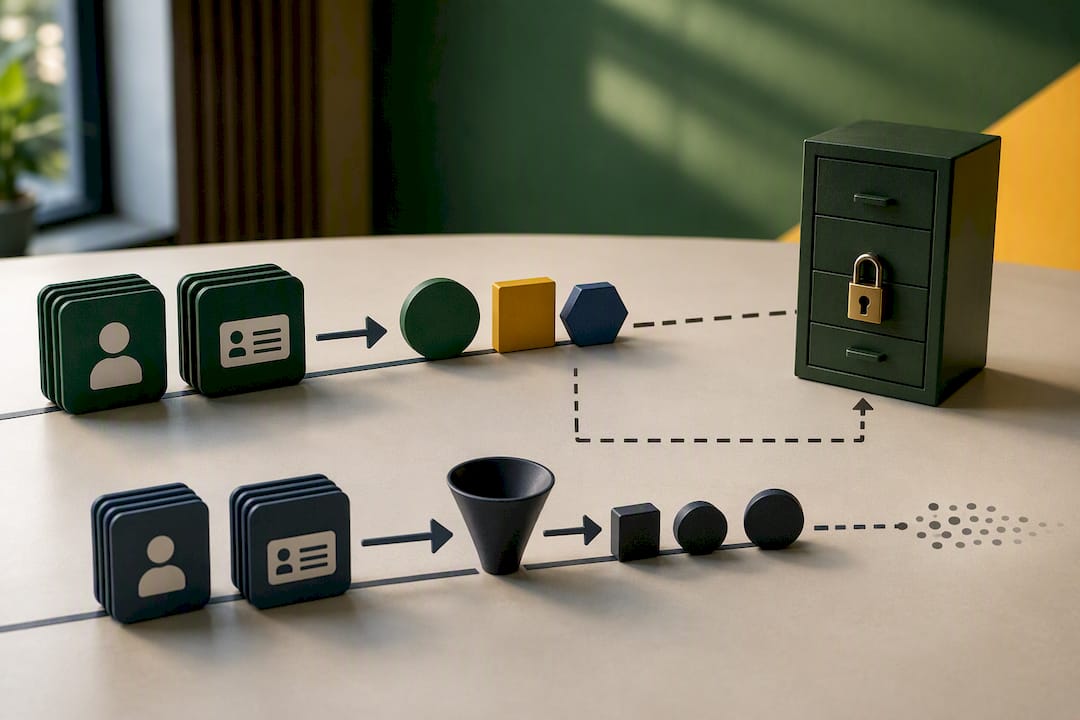
True anonymization strips identifiers permanently, with no mapping table and no path back to the original record. This fits use cases like aggregate reporting or model training on transaction patterns, where the goal is statistical insight rather than individual account tracking. Applying full anonymization to data still needed for client-specific tax filing defeats the purpose of extracting it in the first place, so the choice depends entirely on downstream use.
The practical rule: pseudonymize data that stays in an active workflow, anonymize data before it leaves that workflow for any secondary purpose, including analytics dashboards, vendor benchmarking, or AI model improvement. Any OCR vendor using customer data to refine its own models should disclose that use explicitly and offer an opt-out, since extracted transaction data entering a training set without consent is one of the more common blind spots in AI-era financial data handling.
What Monitoring and Alerting Should Run Continuously?
A control that isn't monitored is a control you're hoping works. Effective monitoring for OCR workflows centers on a few specific signals rather than generic log noise.
Watch for volume anomalies: a user or API key suddenly pulling ten times the normal number of statements in an hour is either a legitimate batch job someone forgot to flag or an exfiltration attempt, and the alert should fire either way. Watch for access pattern shifts: an account that normally touches client files during business hours suddenly active at 2 a.m., or a service account accessing data outside its documented scope.
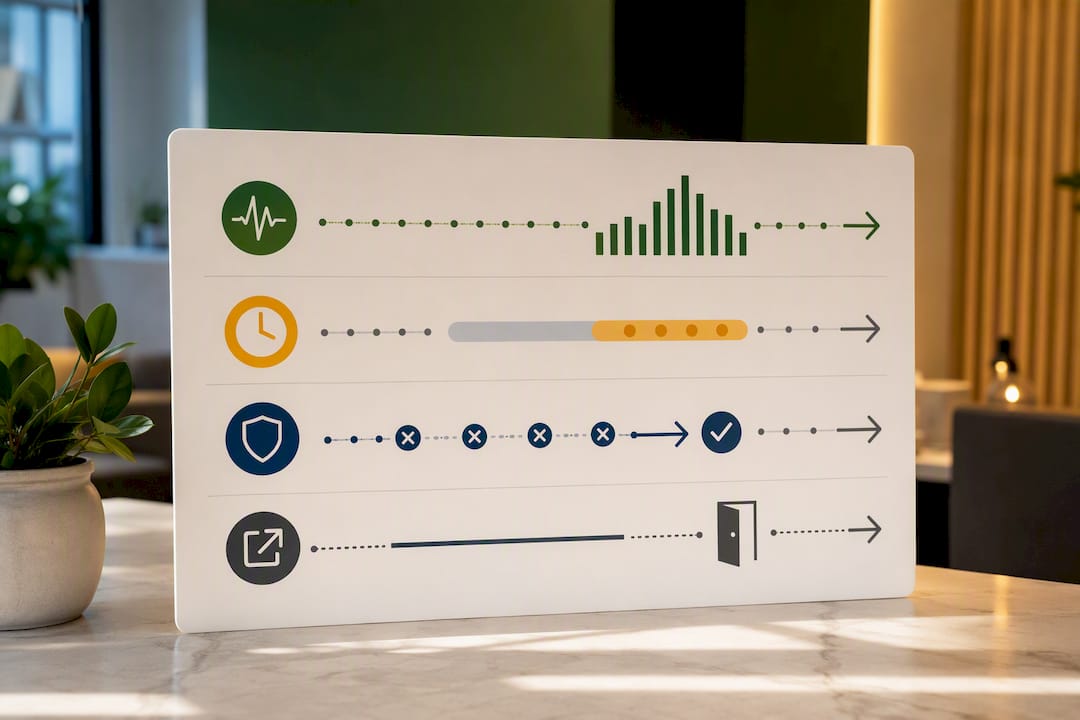
Failed authentication clustering matters more than any single failed login. A pattern of repeated failures against the same account, followed by a success, is a textbook credential-stuffing signature worth an automatic lockout and a real-time alert, not a weekly report someone reads three days later.
Export monitoring deserves particular attention in OCR pipelines specifically, since the export stage is where structured data leaves the controlled environment. Logging every export event, who triggered it, what data it contained, and where it went, gives you the forensic trail needed if a client later asks where their data ended up. Combine this with just-in-time API credentials and scoped service accounts, an approach that limits the blast radius of a single compromised key rather than exposing your entire pipeline to it, and pair automated deprovisioning with periodic access attestation so stale permissions don't quietly accumulate.
Alerts only matter if someone owns the response. Route them to a specific person or team with a defined service level, not a shared inbox that turns into an unread queue by the second week.
Author Perspective: Recommended Priorities and Next Steps
Most security teams over-invest in reading vendor marketing pages and under-invest in asking for the auditor's name on the SOC 2 report. That single question filters out more weak vendors than a twenty-item feature checklist. Run a real pilot before you commit: an isolated sample dataset, a full audit log review of that sample, and a tabletop incident test with the vendor's team in the room. If a vendor resists any of those three, that resistance is the answer. Ask for evidence, validate it independently, then pilot before you sign anything long-term.
— Ian
Get Audit-Ready Statement Conversion Without the Manual Risk
Manual data entry and generic OCR tools both leave gaps this article just walked through: unencrypted intermediate files, no audit trail, no documented incident response. TaxBatchPro closes those gaps by design, converting a year's worth of bank and credit card statements into Schedule C-ready spreadsheets through a secure, batch-capable pipeline built for accountants and firms that can't afford a vague answer during a client audit.
The platform supports the controls this article covers directly: encrypted processing, configurable retention windows, and structured exports mapped to IRS categories so nothing gets re-keyed by hand. Firms managing multiple clients use the accountant-focused workflow to standardize extraction across every engagement without adding headcount or expanding who touches raw statement data. If you want to see extraction accuracy on your own files before committing to a plan, start with the free conversion tool and run a real statement through it today.
Sources
- CFR — GLBA Safeguards Rule (part 314)
- Data security in financial services: core protection strategies and best practices
- SOC 2 Type II Compliance Checklist for Bank-Statement OCR Pipelines in 2025 | Veryfi